
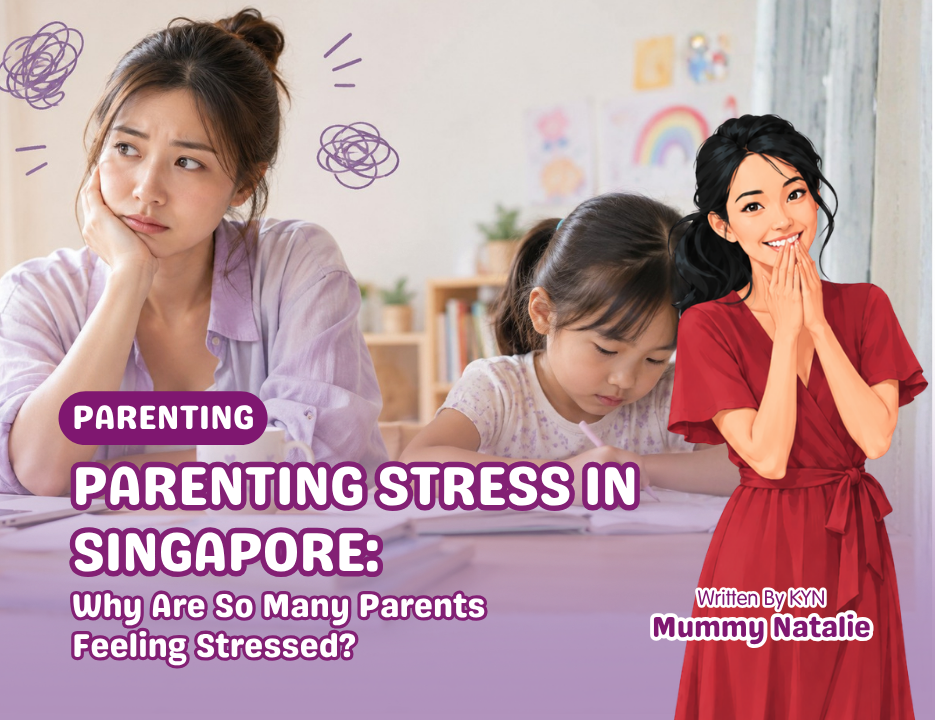
For years, Singapore parenting has been associated with words like kiasu, tuition, enrichment and academic pressure.
But perhaps the bigger conversation today is not simply about being kiasu.
It is about being stressed.
A new 2026 study by the Institute of Policy Studies (IPS) gives us a glimpse into just how widespread that feeling has become. Among 1,500 Singapore Citizen and Permanent Resident parents with children in local primary schools, 87.9% reported experiencing stress related to their children’s education. That is up from 73.1% in 2016.
That means almost nine in 10 parents surveyed had experienced this kind of stress.
And interestingly, the source of that stress appears to be changing.
We may be less stressed about exams, but more worried about the future
You might expect that changes to Singapore’s education system would have reduced some of the pressure parents feel.
Over the past decade, Singapore has introduced changes such as the Achievement Level scoring system for PSLE, the removal of mid-year examinations and Full Subject-Based Banding.
The IPS study found that parents are indeed reporting less stress around some of the things that used to dominate family life, particularly homework and preparing children for examinations.
But that does not mean parents have stopped worrying.
Instead, their concerns have become broader.
Parents are now more likely to worry about whether their child is achieving the grades they are capable of, whether they are keeping up with what is taught in school, and whether they might lose out in the education system in the longer term.
In other words, the question has shifted from:
“Will my child do well in this exam?”
to:
“Will my child be okay in the future?”
And that is a much harder question to switch off.
Parenting stress is no longer just about grades
One interesting finding from the study is that parents themselves appear to be embracing a broader definition of success.
In 2026, 79% of parents agreed that children should be allowed to fail and learn from their mistakes, compared with 62.2% in 2016.
Parents also placed greater importance on character, values, social-emotional development and their child’s own preferences when thinking about schools.
So many parents are saying they want their children to be happy, confident, resilient and well-rounded.
Yet at the same time, they are still worried about grades, school choices and their children’s future.
This creates a difficult balancing act.
We want our children to enjoy childhood.
We want them to discover their interests.
We want them to be emotionally healthy.
But we also worry that if we do not give them enough support, tuition, enrichment or opportunities, they might fall behind.
And sometimes, the pressure comes not from one big decision, but from hundreds of little ones.
Should we get a tutor?
Should we enrol them in enrichment?
Are they reading enough?
Should they be doing more maths?
Is everyone else doing more than us?
Are we being too relaxed?
Or are we pushing too hard?
The tuition paradox
The IPS study captures this contradiction particularly well.
Nearly nine in 10 parents agreed that children in Singapore spend too much time on tuition and enrichment.
Yet 70.2% said they would spend more on tuition and enrichment if they had the resources to do so.
Why?
Because knowing that something may be adding pressure does not necessarily make it easy to opt out.
When parents believe that other children are getting additional support, choosing not to participate can feel like taking a risk with your own child.
The study found that 51.9% of parents reported feeling pressure because other parents spent money on tuition and enrichment.
This is where parenting stress can become self-perpetuating.
One family signs up for another class.
Another family sees it and wonders if they should do the same.
Soon, what started as an optional activity can begin to feel like a necessity.
And the pressure can enter our marriages too
Parenting stress does not always stay inside our own heads.
It can spill into our relationships.
The proportion of parents who reported arguing with their spouse over their children’s education increased from 42.8% in 2016 to 59.7% in 2026.
It is easy to imagine how this happens.
One parent thinks the child needs more support.
The other thinks the child needs more rest.
One wants to sign up for another class.
The other thinks there are already too many.
One worries that they are not doing enough.
The other worries that they are doing too much.
Neither necessarily wants to put more pressure on the child.
Both are simply trying to be a good parent.
And sometimes, that is exactly what makes parenting stress so difficult.
So, what can parents actually do?
There is no single solution to parenting stress.
And telling parents to “just relax” is probably not particularly helpful.
But there are small ways we can start changing the way we carry the pressure.
1. Ask yourself: “Is this my child’s need, or my fear?”
Before adding another class, activity or goal to the calendar, pause.
Does your child genuinely need this?
Or are you worried that other children are getting ahead?
That small distinction can help separate your child’s needs from our own anxiety about the future.
2. Stop measuring your parenting against someone else’s
You rarely see the full picture of another family.
You see the tuition class, the competition result or the enrichment certificate.
You do not see their arguments, exhaustion, financial pressure or bedtime battles.
Your child does not need to follow someone else’s parenting plan.
3. Leave some room for ordinary childhood
Not every hour needs to be productive.
Children need time to play, daydream, talk nonsense, get bored and simply be with their parents.
Those moments may not appear on a school application, but they are still part of growing up.
4. Talk to your partner about the fear underneath the disagreement
Sometimes the argument is really not about tuition.
It is about fear.
“I don’t want our child to fall behind.”
“I don’t want our child to feel pressured.”
“I don’t want us to regret not doing more.”
Talking about the fear rather than just arguing about the decision can make the conversation very different.
5. Give yourself permission to be a “good enough” parent
There will always be another thing you could be doing.
Another book you could buy.
Another activity you could try.
Another milestone you could worry about.
But parenting is not a checklist where completing everything guarantees a particular outcome.
Sometimes, doing enough really is enough.
Perhaps Singapore parenting needs a new definition of “doing well”
The interesting thing about the 2026 IPS findings is that Singapore parents are not necessarily becoming less ambitious for their children.
They appear to be trying to broaden what success means.
They want good education, but they also want happy learning.
They care about achievement, but they also care about character.
They want their children to succeed, but increasingly recognise that children also need room to fail and learn.
The challenge is making sure our definition of a “successful childhood” does not become so broad that parents feel they have to optimise everything.
Because perhaps that is the real parenting trap.
We start by wanting to give our children every opportunity.
Then every opportunity starts to feel necessary.
And before we know it, we are exhausted from trying to give our children the childhood we think they need.
Maybe the question is not whether we are doing enough for our children.
Maybe sometimes we need to ask whether what we are doing is helping our whole family feel better, too.
After all, children do not only experience the pressure we talk about.
They also experience the pressure we carry.
Hello! I am Mummy Natalie

I am one of the editors of KidYouNot Parenting Blog! coffee is my life saviour as a mum of two. My parenting philosophy? Hugs, love, and lots of patience (because honestly, some days need all three). I enjoy sneaking in kopi breaks, spontaneous family makan sessions, and turning everyday chaos into fun memories.
Join KidYouNot SG Parenting Community
Sign up to become a member and gain access to exclusive parenting tips, special deals, and early updates on new products and events.
Follow us on Instagram and Telegram to connect with other parents, share your journey, and enjoy fun, supportive content every day!