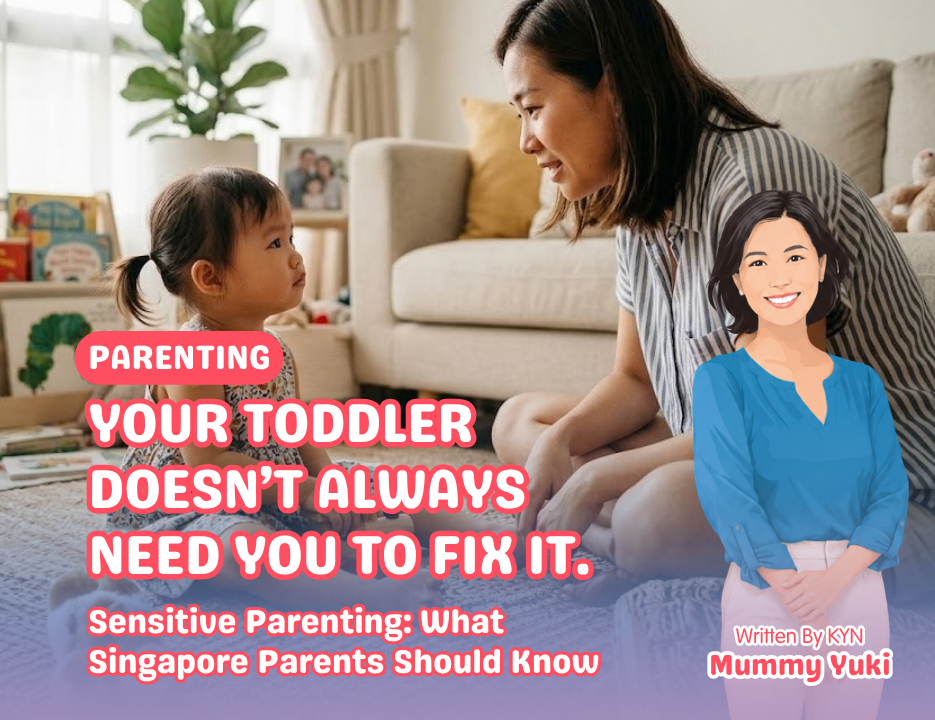
For years, parents have heard phrases like “connect before you correct” and “respond, don’t react”. They sound good in theory but when your toddler is screaming in the supermarket, throwing food across the table or melting down because you gave them the “wrong” cup, what does responsive parenting actually look like?
Now, researchers in Singapore are taking a closer look at that question.
The LOVING study, a major parenting intervention study involving 624 families, brings together researchers from NUS, A*STAR, KK Women’s and Children’s Hospital (KKH) and NTU to study how sensitive caregiving may influence children’s development.
At the heart of the study is a simple idea: how parents notice, understand and respond to their child’s cues matters.
And importantly, this isn’t about getting parenting “perfect”.
It’s about learning to see what your child may be communicating, even when the communication looks like a tantrum.
What is sensitive parenting?
Sensitive parenting is about being able to notice your child’s signals, understand what they may mean and respond appropriately.
That sounds straightforward. But toddlers aren’t exactly known for expressing themselves clearly.
A toddler who screams when you leave the room may not be “being difficult”.
They may be saying:
“I don’t feel safe when you go.”
A toddler who suddenly refuses dinner may not simply be “fussy”.
They may be saying:
“I’m exhausted and I can’t handle another demand right now.”
And a toddler who collapses on the floor because you said no?
They may be saying absolutely nothing coherent at all because they’re still learning how to regulate big emotions.
That’s where sensitive parenting comes in.
Instead of immediately asking:
“How do I stop this behaviour?”
you start by asking:
“What is my child trying to tell me?”
Connection doesn’t mean giving in
This is where sensitive parenting can sometimes be misunderstood.
Responding to your child’s emotions doesn’t mean saying yes to everything.
You can acknowledge the feeling and still hold the boundary.
Your toddler wants another biscuit.
You can say:
“I know you really want another one. You’re upset because I said no. But we’ve had enough biscuits.”
You’re not removing the boundary.
You’re helping your child experience something important:
“My feelings are allowed, even when the answer is no.”
That’s very different from permissive parenting.
Sensitive parenting isn’t about letting your child run the show. It’s about recognising that behaviour is communication, especially when a child doesn’t yet have the language or emotional skills to explain what’s happening inside them.
5 tiny things responsive parents do differently
1. They pause before reacting
Your toddler screams.
Your first instinct might be to say:
“Stop screaming!”
But sometimes, taking one breath before responding changes the entire interaction.
What happened just before the screaming?
Were they hungry? Tired? Overstimulated? Frustrated? Struggling with a transition?
You don’t always need to know the answer immediately.
The pause simply gives you a chance to respond rather than automatically react.
2. They look beyond the behaviour
Instead of seeing only “tantrum”, try looking for the need underneath it.
A meltdown before bedtime could be tiredness.
Clinging at preschool drop-off could be separation anxiety.
Hitting when another child takes a toy could be frustration and an inability to express it appropriately.
Understanding the reason doesn’t mean excusing the behaviour.
It means you can address both the behaviour and the need behind it.
3. They get down to their child’s level
Sometimes, the most powerful thing you can do is physically slow down.
Get down beside your child.
Make eye contact.
Use fewer words.
Keep your voice calm.
A dysregulated toddler isn’t always capable of processing a long explanation about why their behaviour is inappropriate.
Sometimes, they need help calming down first.
Regulation often comes before reasoning.
4. They name what they see
You don’t need a perfect parenting script.
Simple observations can help:
“You’re really upset.”
“You didn’t want Mummy to leave.”
“You wanted the blue cup, not the green one.”
You’re not necessarily agreeing with the behaviour.
You’re helping your child put words to an experience they may not yet understand themselves.
Over time, that emotional vocabulary becomes something they can use independently.
5. They don’t expect themselves to get it right every time
Perhaps this is the most important one.
Sensitive parenting doesn’t mean being calm, patient and emotionally available every single second of every single day.
Parents get tired.
Parents lose their patience.
Parents sometimes say things they wish they hadn’t.
What matters is that you can reconnect afterwards.
“Mummy was very frustrated earlier. I’m sorry I shouted.”
That moment matters too.
Because you’re showing your child that relationships can survive difficult moments — and that people can repair after they’ve hurt one another.
Your toddler is communicating, even when they’re screaming
One of the biggest shifts in parenting is learning to look at behaviour differently.
Not:
“How do I make this stop?”
But:
“What might my child be communicating?”
Sometimes the answer will be obvious.
Sometimes it won’t.
And sometimes your toddler is simply overtired and needs a nap.
That’s okay too.
Sensitive parenting isn’t about decoding every cry, tantrum or strange toddler behaviour like a puzzle.
It’s about becoming more curious about your child’s experience.
And that’s a meaningful shift from control to connection.
What the LOVING study could tell us
The Singapore LOVING study is looking at sensitive caregiving and its potential effects across areas of children’s emotional, cognitive and physical health.
That makes this conversation particularly interesting for Singapore parents.
We’re not just talking about an online parenting trend or another set of Instagram parenting rules.
Researchers are studying what happens when parents are supported in becoming more sensitive and responsive to their children’s cues and whether that can make a meaningful difference to children’s development.
As the research develops, it could give parents a clearer understanding of something many families are already discovering in everyday life:
How we respond to our children matters.
Not because we need to become perfect parents.
But because those tiny moments, noticing, listening, pausing, responding, happen hundreds of times throughout childhood.
And sometimes, the thing your toddler needs most isn’t another solution.
They just need you to notice.
Hello! I am Mummy Yuki

I am one of the editors of KidYouNot team! As a WFH mum, I love quiet mornings, soft music, and messy play is my kind of vibe. I’m all about slow parenting, art time, and letting kids be kids.
Join KidYouNot SG Parenting Community
Sign up to become a member and gain access to exclusive parenting tips, special deals, and early updates on new products and events.
Follow us on Instagram and Telegram to connect with other parents, share your journey, and enjoy fun, supportive content every day!