A Conversation Many Couples Are Having Later
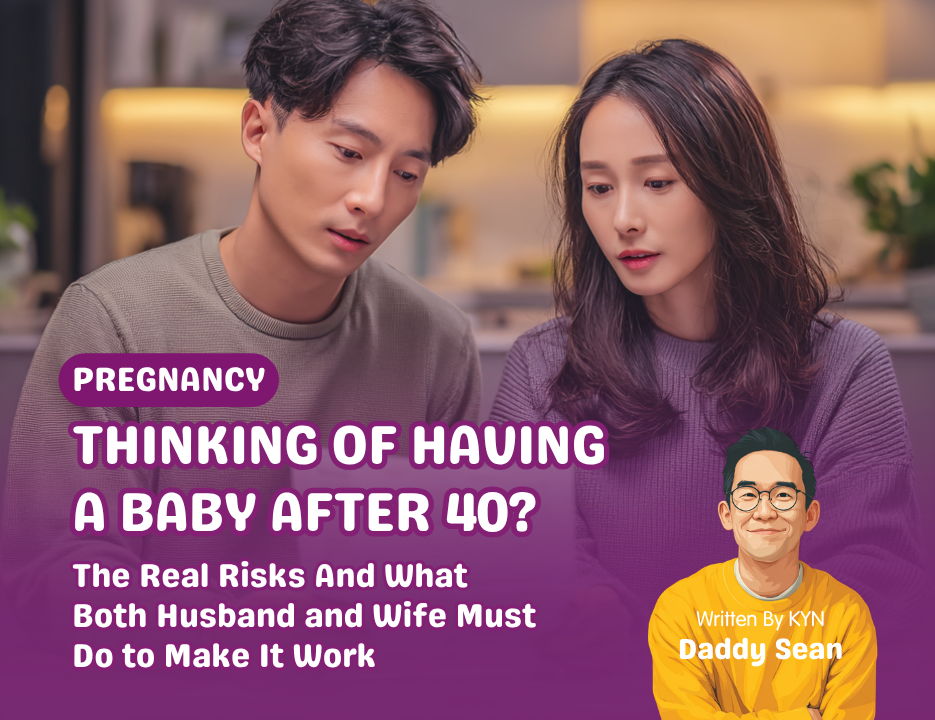
My wife and I had this conversation later than most.
Not in our early 30s, and not even mid-30s. Closer to 40, like many couples in Singapore who spent years focusing on career, stability, and timing before seriously considering starting a family.
At some point, the question became unavoidable: if we wanted a child, was it still realistic?
I started researching more systematically than I expected. Medical sources, local hospital guidance, and fertility data. The conclusions were not comforting, but they were clear.
What the Data Actually Shows After 40
By age 40, fertility declines are no longer gradual. They become significant.
Clinical guidance from hospitals such as Mount Elizabeth Hospital and KK Women’s and Children’s Hospital consistently highlights that:
- The chance of natural conception drops to about 5% per cycle
- Miscarriage risk rises to approximately 30–40%
- Risks of gestational diabetes and hypertension increase noticeably
For the baby, there is:
- A higher probability of chromosomal conditions such as Down syndrome (around 1 in 100 at age 40)
- Increased likelihood of preterm birth
According to guidance published by KK Women’s and Children’s Hospital:
“Women aged 40 and above can still achieve successful pregnancies, but require closer monitoring due to increased obstetric risks.”
These are not marginal differences. They are clinically meaningful.
But they are also frequently misinterpreted. These figures describe risk, not certainty. In Singapore, where prenatal care is highly developed, many women in their 40s still deliver healthy babies.
The Overlooked Factor: It Is Not Just About the Woman
One of the most consistent findings across what I read was this:
Fertility is often framed as a female issue, but medically, that is incomplete.
Data from fertility centres in Singapore, including Thomson Fertility Centre, indicates that male factors contribute to roughly 30–40% of infertility cases.
Age also affects men. Sperm quality declines over time, and is influenced by lifestyle, stress, and overall health.
This shifted how we approached the process.
1. We Treated Fertility as a Husband and Wife Issue
Instead of assuming my wife should be the one to “check first”, we both went for assessments.
She underwent hormone profiling and ovarian reserve testing. I did a full sperm analysis.
We chose to do this early through providers such as Gleneagles Hospital.
The outcome was not just medical clarity. It removed uncertainty.
Rather than spending months guessing, we understood where we stood from the start.
2. We Aligned on Time, Not Assumptions
One of the less obvious challenges was not biological. It was psychological.
I initially assumed we had more time. My wife did not.
Without addressing this directly, it could easily have created tension.
We agreed early on:
- How long we would try naturally
- When we would seek medical advice
- What options we were open to
This alignment mattered more than I expected. It reduced pressure and prevented delays that often come from indecision.
3. I Had to Change My Lifestyle Too
This was one of the more uncomfortable parts of the process.
There is a tendency to view pregnancy preparation as something the woman undertakes, while the man remains largely unchanged. The research does not support that.
Studies consistently show that sperm quality is affected by:
- Sleep
- Alcohol consumption
- Diet
- Stress levels
There is also evidence that improvements in these areas can lead to measurable changes within approximately three months.
I had to take that seriously. Not as a symbolic gesture, but as a practical step.
This reframed my role. I was not just supporting my wife. I was part of the biological equation.
4. We Did Not Wait Too Long to Seek Help
In younger couples, it is common to try for a year before seeking medical advice.
After 40, that approach is less advisable.
Guidelines from Singapore-based providers suggest that couples in this age group should consider seeking help after about six months, or earlier if there are known concerns.
We agreed on this upfront.
Facilities such as Mount Elizabeth Hospital and Thomson Fertility Centre offer a range of fertility support, but the key factor is timing.
Delays reduce options. Early action preserves them.
5. We Planned for Life After Pregnancy, Not Just Conception
Most discussions around having a child after 40 focus on whether conception is possible.
Less attention is given to what happens after.
Recovery can be slower. Physical demands may feel different compared to a decade earlier. Support systems become more important.
We approached this practically:
- Who would help after birth
- How work would be managed
- What kind of support we would need
This shifted our thinking.
The question was no longer just whether we could have a child, but whether we were prepared to raise one at this stage of life.
A Perspective That Changed My Mind
At the start, I assumed that age-related fertility challenges were primarily a women’s issue.
That assumption did not hold up.
Male age, health, and decision-making all play a role. In many cases, delays are not purely biological, but behavioural. They come from hesitation, misalignment, or the belief that there is still time.
That dynamic is rarely discussed, but it matters.
Final Thoughts
Having a baby after 40 is different.
The risks are higher. The margin for delay is smaller. The process requires more intention.
But the outcome is not determined by age alone.
It is shaped by how early a couple acts, how well they understand the risks, and how prepared they are to approach it as a shared responsibility.
For us, the shift was straightforward in principle.
We stopped asking whether it was still possible, and started asking whether we were prepared to do it properly, as husband and wife.
That made the difference.
Hello! I am Daddy Sean

I am one of the editors of KidYouNot Parenting blogs! I have two adorable sons. I’m a nature lover who values wellbeing and mindful parenting. I’m all about creating balance, connection, and joy in family life.
Join KidYouNot SG Parenting Community
Sign up to become a member and gain access to exclusive parenting tips, special deals, and early updates on new products and events.
Follow us on Instagram and Telegram to connect with other parents, share your journey, and enjoy fun, supportive content every day!