Maybe it happens in stressful moments.
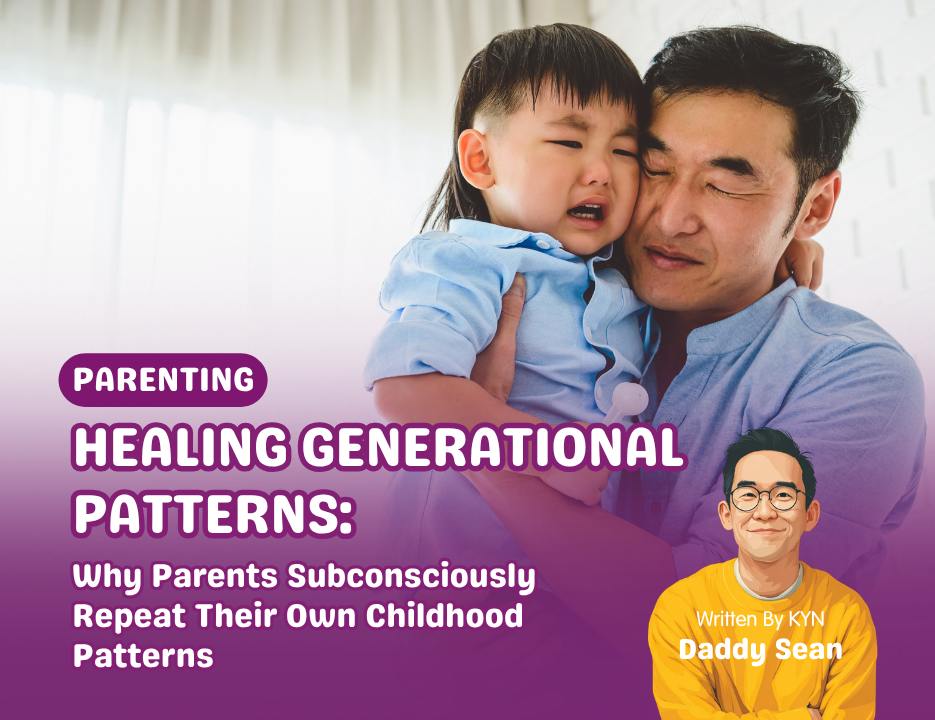
Your child spills something, throws a tantrum, or talks back… and suddenly, words come out of your mouth that sound eerily familiar.
“Stop crying.”
“Don’t be so sensitive.”
“Because I said so.”
And afterwards, you pause and think:
Wait… that sounded exactly like my mum.
Many parents experience this, often without realising it.
According to research in developmental psychology, parenting behaviours and emotional responses are often passed down across generations through modelling, attachment patterns, and learned emotional regulation.
In simple terms: the way we were parented shapes the way we instinctively respond to our own children.
Dr Daniel Siegel, clinical professor of psychiatry and author of The Whole-Brain Child, explains it this way:
“The most powerful predictor of a child’s wellbeing is a parent’s self-understanding.”
In other words, healing ourselves matters more than trying to become a “perfect parent.”
The Patterns We Inherit
Generational patterns are emotional habits, beliefs, and parenting behaviours passed down from one generation to another.
Some patterns are deeply positive:
- resilience
- strong family loyalty
- prioritising education
- sacrifice and responsibility
But some patterns can quietly carry emotional wounds too:
- emotional suppression
- harsh discipline
- fear-based parenting
- perfectionism
- people-pleasing
- avoiding difficult conversations
In many Asian households, love was often shown through provision rather than emotional expression.
Parents worked hard.
Food was always on the table.
Children were cared for physically.
But emotional validation, open conversations, and mental health awareness were not always prioritised because many parents themselves grew up in survival mode.
Psychologists often call this “intergenerational transmission” where stress, coping mechanisms, and emotional behaviours get unconsciously passed down within families.
Why Parenting Can Feel So Triggering
One surprising truth about parenting is this:
children often activate unresolved parts of ourselves.
A child crying loudly in public may trigger shame.
A child expressing anger may feel “disrespectful.”
A child making mistakes may trigger anxiety around failure.
Sometimes our reactions are not only about our child’s behaviour.
They are connected to what that behaviour meant in the environment we grew up in.
Dr Gabor Maté, known for his work on childhood trauma and emotional health, once shared:
“The issue is not why the addiction, but why the pain.”
While he was referring to emotional pain more broadly, the same idea applies to parenting reactions too. Many emotional responses are rooted in old wounds, stress, fear, or unmet emotional needs carried from childhood.
The Modern Parenting Shift
Today’s parents are trying to parent differently.
We hear more conversations around:
- gentle parenting
- emotional regulation
- respectful communication
- breaking toxic cycles
- mental wellbeing
But many parents are also carrying inherited beliefs like:
- “Children should obey without questioning.”
- “Crying is weakness.”
- “Strict parenting creates successful kids.”
- “Good children don’t talk back.”
This creates an internal conflict.
We want to raise emotionally secure children, but sometimes our nervous systems were shaped in environments where emotional expression did not feel safe.
That is why healing generational patterns is not simply about learning parenting techniques.
It is also about unlearning survival responses.
Healing Starts With Awareness
Breaking cycles does not happen in one perfect parenting moment.
It begins with awareness.
Noticing:
- when you react instead of respond
- when your child’s emotions overwhelm you
- when you repeat phrases you once disliked hearing
- when fear controls your parenting decisions
Awareness matters because unconscious patterns cannot change.
Research from Harvard’s Center on the Developing Child shows that responsive, emotionally safe relationships help shape healthier stress responses and emotional resilience in children.
A parent who reflects, repairs, and responds differently is already creating change.
Healing Does Not Mean Becoming Perfect
Many parents today place enormous pressure on themselves to “break every cycle.”
But healing is not perfection.
You will still lose patience sometimes.
You will still feel triggered.
You will still make mistakes.
The difference is what happens after.
Healing parents repair.
They apologise.
They reconnect.
They reflect.
They try again.
For many adults, childhood wounds were not created by one difficult moment, but by the repeated absence of emotional repair afterwards.
And this is where parenting can become transformative.
Because every time a parent chooses connection over fear, awareness over autopilot, or repair over ego, a generational cycle begins to shift.
Small Ways to Start Healing Generational Patterns
1. Pause Before Reacting
Even a few seconds can interrupt automatic responses learned from childhood.
2. Validate Feelings While Holding Boundaries
You can say:
“I know you’re upset.”
without allowing harmful behaviour.
Validation teaches children that emotions are safe.
3. Apologise When Necessary
Research shows that parental repair strengthens trust and emotional security.
Apologising models accountability, not weakness.
4. Speak to Your Child the Way You Needed Someone to Speak to You
This can be unexpectedly healing for both parent and child.
5. Heal Yourself Alongside Your Parenting Journey
Therapy, journaling, mindfulness, nervous system work, support groups, or self-reflection can all help uncover unconscious patterns.
Sometimes the greatest parenting work happens internally.
Final Thoughts
Every generation parents differently because every generation learns something new.
Our parents may have focused on survival.
This generation is learning emotional awareness.
And perhaps healing generational patterns is not about blaming previous generations.
It is about recognising:
“They gave me what they knew.”
And now, we choose what we pass on next.
Maybe that is how cycles change.
Not perfectly.
But consciously.
Hello! I am Daddy Sean

I am one of the editors of KidYouNot Parenting blogs! I have two adorable sons. I’m a nature lover who values wellbeing and mindful parenting. I’m all about creating balance, connection, and joy in family life.
Join KidYouNot SG Parenting Community
Sign up to become a member and gain access to exclusive parenting tips, special deals, and early updates on new products and events.
Follow us on Instagram and Telegram to connect with other parents, share your journey, and enjoy fun, supportive content every day!