Can We Use Violence to Right a Wrong?
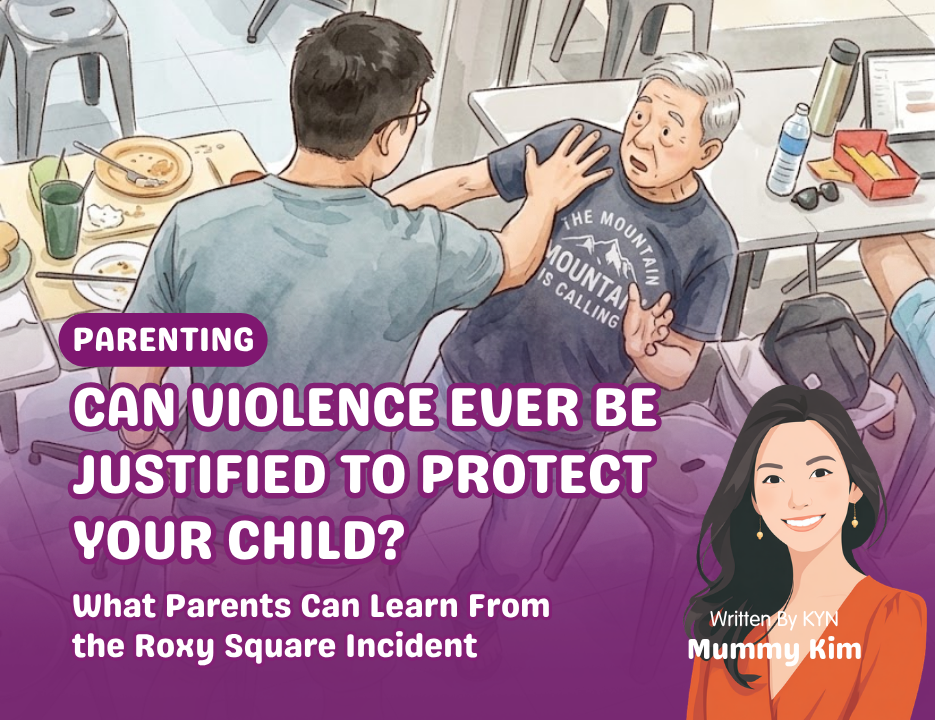
The recent incident at Roxy Square has been difficult to ignore.
A 73-year-old man was allegedly shoved to the ground after patting a young girl’s head. The incident has since triggered a familiar kind of online debate: some people see a father protecting his daughter, while others see an act of violence against an elderly man.
The police have identified the man involved and investigations are ongoing, so there is still much we do not know about what happened in those few moments.
But as a parent, I find myself less interested in deciding who was right or wrong than in asking a more uncomfortable question:
What do we teach our children about responding when someone does something wrong to them?
Because this is where parenting gets complicated.
We spend years telling our children that hitting is not an acceptable way to solve a problem. When another child grabs a toy, pushes them or hurts them, we tell them to use their words, seek help and walk away rather than retaliate.
Then one day, someone crosses a line with our child.
And suddenly, the calm parenting advice can feel much harder to follow.
The instinct to protect is real
I can understand why a parent might react strongly if a stranger touches their child.
For some families, a pat on the head may seem completely harmless. For others, it may feel like an invasion of a child’s personal space. Children should certainly learn that they have a say over who touches them, and parents have every reason to step in when they feel their child’s boundaries have been crossed.
If that was what the father was trying to communicate, the intention is understandable.
But intention and action are not necessarily the same thing.
There is a difference between telling someone, firmly, not to touch your child and physically hurting them because you are angry about what they have done.
That distinction matters, especially when our children are watching.
Our children are learning from the moments we lose our temper
This is probably the part that makes me uncomfortable.
When we talk about modelling behaviour for our children, we tend to think about the obvious things: saying please and thank you, sharing, apologising, being kind.
But children are also watching what happens when we are furious.
They see how we react when someone cuts in front of us in traffic. They hear how we speak about someone who has upset us. They notice what happens when another child takes their toy or when an adult behaves badly.
And they are particularly likely to remember what we do when we are angry on their behalf.
A child may not understand all the circumstances surrounding an altercation. They may simply see that someone crossed a boundary and an adult responded with physical force.
That raises an uncomfortable possibility: are we teaching our children that violence is wrong, or that violence is acceptable when we believe we are justified?
But protecting our children does not mean standing by
There is a danger, too, in taking the argument too far.
Choosing not to respond violently does not mean parents should tolerate inappropriate behaviour towards their children.
Quite the opposite.
Children need adults who will notice when something is wrong and step in. They need to know that their discomfort matters and that they can tell us when someone has made them uncomfortable.
There is nothing wrong with being angry when someone crosses a boundary involving our child. Anger can be useful. It tells us that something matters.
The challenge is what we do with that anger.
Because once we move from stopping a situation to hurting someone in retaliation, we are no longer simply protecting our child. We are making another choice, one that carries consequences of its own.
This is where the phrase “righting a wrong” becomes dangerous
We often justify our actions by the reason behind them.
They started it.
They shouldn’t have touched my child.
They deserved it.
They needed to learn a lesson.
But if we allow ourselves to decide that another person’s wrongdoing gives us permission to hurt them, where does that reasoning stop?
The original act may have been inappropriate. It may have been insensitive. It may even have been frightening.
But does that make every response to it acceptable?
I don’t think it does.
And that is not because I believe parents should be passive. It is because I don’t want my child to grow up believing that being right gives us permission to do wrong.
What would I want my child to do?
This is probably the question I would rather ask myself.
If another child pushed my son, I wouldn’t want him to push back simply because he was angry.
If someone said something cruel to him, I wouldn’t want him to hurt them because they “deserved it”.
If someone crossed his physical boundaries, I would want him to know that he can say no, move away and find an adult who can help.
And if someone genuinely threatened his safety, I would want him to know the difference between protecting himself and taking revenge.
Perhaps that is the distinction we need to make as parents too.
Self-defence and retaliation are not the same thing.
Protecting someone from immediate harm is different from hurting someone because we believe they deserve it.
The hardest part may be controlling ourselves
Parenting often asks us to teach lessons that we are still learning ourselves.
We tell our children to take a breath when they are angry, while sometimes struggling to take one ourselves.
We tell them not to hit when they are frustrated, while knowing how difficult it can be to stay composed when someone has upset our child.
And perhaps that is why incidents like this hit such a nerve.
Most parents probably recognise the feeling, even if they would not respond in the same way.
That surge of anger when you think someone has treated your child badly.
The instinct to step in.
The feeling that, How dare you?
That instinct isn’t something we need to be ashamed of. It is part of being a parent.
But perhaps being a good parent means learning not to let that instinct make every decision for us.
Because one day, our children will face these situations without us
We won’t always be there to speak for them.
They will have disagreements at school. They will encounter people who are rude, insensitive or unfair. Someone will hurt their feelings. Someone may cross a boundary.
We cannot protect them from every difficult interaction.
What we can do is give them a framework for dealing with those moments.
I want my child to know that he is allowed to stand up for himself. I want him to know that his body belongs to him and that he doesn’t have to accept behaviour that makes him uncomfortable.
But I also want him to understand that another person’s bad behaviour does not automatically give him permission to hurt them.
Because ultimately, that is the lesson behind all of this.
We teach our children that hitting is not how we solve problems. Perhaps we need to hold ourselves to the same standard, especially when we are angry enough to think we are justified.
The Roxy Square incident may eventually be resolved by the authorities, and the full circumstances may become clearer.
For parents, though, there is another conversation worth having – what happens when our protective instinct collides with our responsibility to model the behaviour we expect from our children.
Because when our children are watching, how we respond to a wrong may become a bigger lesson than the wrong itself.
Hello! I am Mummy Kim!

A beauty-loving mum who believes that looking good and feeling good go hand in hand. My parenting mantra is raising happy, confident kids with strong self-esteem! Between facial masks and storybooks, I’m all about nurturing both inner and outer beauty, for myself and my little ones.
Join KidYouNot SG Parenting Community
Sign up to become a member and gain access to exclusive parenting tips, special deals, and early updates on new products and events.
Follow us on Instagram and Telegram to connect with other parents, share your journey, and enjoy fun, supportive content every day!