For generations, strict parenting has been deeply woven into many Asian households.
Children were taught to obey elders, prioritise academic success, and avoid bringing shame to the family.
Discipline was often seen as a reflection of love and responsibility. In Singapore especially, where competition and academic pressure remain intense, many parents believed that being strict was necessary for children to succeed.
But younger parents today are beginning to challenge that mindset.
As conversations around emotional wellbeing, childhood development, and mental health become more common, many Singaporean parents are asking an important question: Is fear-based parenting actually helping children in the long run?
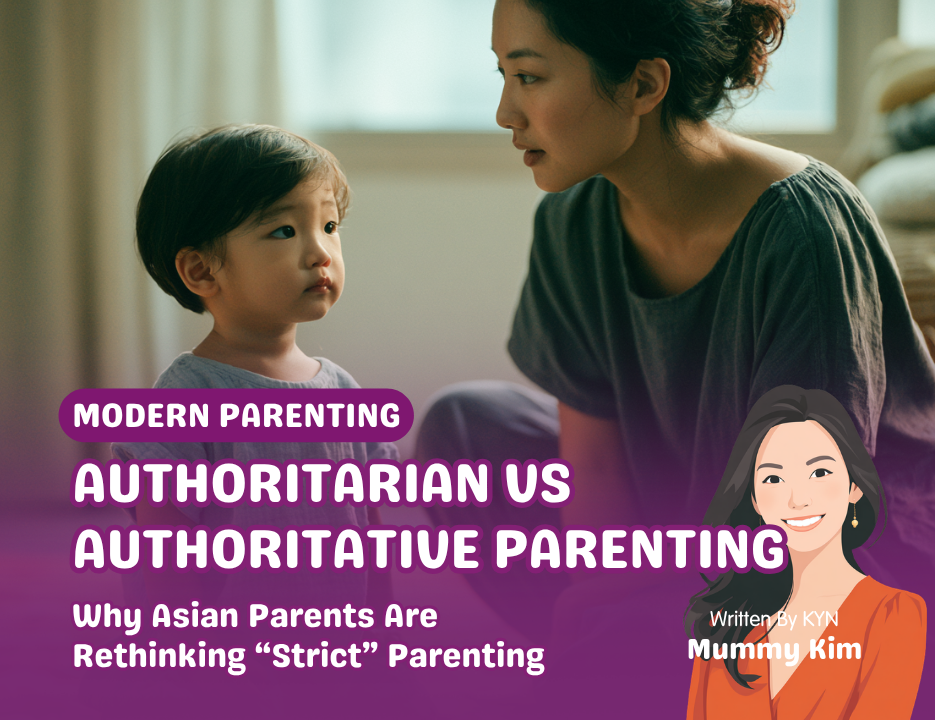
This shift has brought greater attention to two parenting styles often misunderstood or confused with one another: authoritarian parenting and authoritative parenting.
The Parenting Style Many Asians Grew Up With
Authoritarian parenting is commonly associated with traditional strict parenting.
This style focuses heavily on obedience, rules, discipline, and parental authority. Children are expected to listen without questioning, while emotional expression is often discouraged or viewed as disrespectful.
Common phrases associated with authoritarian parenting include:
- “Because I said so.”
- “Don’t talk back.”
- “Stop crying.”
- “You should know better.”
In many Asian families, this approach was not necessarily rooted in cruelty, but in survival, fear, and protection.
Parents who lived through financial hardship or instability often believed strict discipline would prepare children for a competitive world. Good grades, stable careers, and strong obedience were viewed as pathways to security and social mobility.
Singapore’s highly competitive education system further reinforced these parenting patterns. Many parents worried that being too lenient would lead children to become unmotivated or unable to cope with pressure.
While authoritarian parenting can produce disciplined and academically driven children, experts have increasingly pointed to its emotional consequences.
Children raised in highly authoritarian environments may become:
- Fearful of failure
- Emotionally withdrawn
- Highly anxious
- Dependent on external validation
- Uncomfortable expressing emotions openly
Some adults raised this way later struggle with confidence, communication, or emotional intimacy, particularly within family relationships.
The Rise of Authoritative Parenting
In contrast, authoritative parenting combines structure with emotional connection.
This parenting style still includes boundaries, rules, and discipline, but places greater emphasis on communication, emotional safety, and mutual respect.
An authoritative parent may acknowledge a child’s emotions while still maintaining limits. Instead of shutting emotions down immediately, the parent guides the child through them.
For example:
“I understand you’re upset, but hitting is not acceptable.”
The child still learns consequences and boundaries, but without fear becoming the primary teaching tool.
Importantly, authoritative parenting is not permissive parenting. It does not mean allowing children to behave without limits or avoiding discipline altogether.
Rather, it focuses on helping children understand behaviour, develop emotional regulation, and build trust with caregivers.
Research over the years has consistently linked authoritative parenting with:
- Higher self-esteem
- Better emotional regulation
- Stronger social skills
- Greater independence
- Healthier parent-child relationships
Many psychologists consider it one of the most balanced parenting approaches for long-term emotional development.
Why Singapore Parents Are Parenting Differently Today
A growing number of millennial and younger parents in Singapore are consciously trying to break cycles they experienced growing up.
Parenting content on social media, mental health awareness, and increased access to child development information have all contributed to this shift. Conversations around gentle parenting, nervous system regulation, attachment theory, and childhood trauma are becoming increasingly mainstream.
Many parents now recognise that children’s emotional wellbeing is just as important as academic performance.
This does not mean parents are abandoning discipline altogether. Instead, many are searching for ways to raise respectful children without relying primarily on fear, shame, or emotional suppression.
The pandemic years also accelerated these conversations. Spending extended time at home led many parents to reflect more deeply on family relationships, emotional stress, and communication patterns within the household.
The Cultural Tension Modern Asian Parents Face
Despite this shift, parenting differently is not always easy within Asian family structures.
Many Singapore parents still face pressure from older generations who may view softer communication styles as ineffective or overly indulgent.
Comments such as:
- “Kids nowadays are too pampered.”
- “Last time our parents used the cane.”
- “Why are you negotiating with your child?”
remain common in many households.
This creates tension for parents attempting to balance traditional values such as respect and discipline with newer understandings of emotional health and child psychology.
The challenge is not simply choosing between being “strict” or “soft.” For many parents, it is about finding a sustainable balance between authority, guidance, emotional connection, and cultural expectations.
Parenting Beyond Fear
Experts increasingly agree that children learn best when they feel emotionally safe.
Fear may create short-term obedience, but emotional security often builds stronger long-term trust, resilience, and communication.
Children who feel heard and respected are generally more willing to cooperate, express emotions safely, and seek support when needed.
At the same time, parenting experts emphasise that no parent follows one parenting style perfectly all the time. Stress, work demands, financial pressure, and exhaustion can affect even the most intentional parents.
The goal is not perfection, but awareness.
For many Asian parents today, the conversation is no longer simply about raising successful children. It is increasingly about raising emotionally secure ones as well.
Hello! I am Mummy Kim!

A beauty-loving mum who believes that looking good and feeling good go hand in hand. My parenting mantra is raising happy, confident kids with strong self-esteem! Between facial masks and storybooks, I’m all about nurturing both inner and outer beauty, for myself and my little ones.
Join KidYouNot SG Parenting Community
Sign up to become a member and gain access to exclusive parenting tips, special deals, and early updates on new products and events.
Follow us on Instagram and Telegram to connect with other parents, share your journey, and enjoy fun, supportive content every day!