
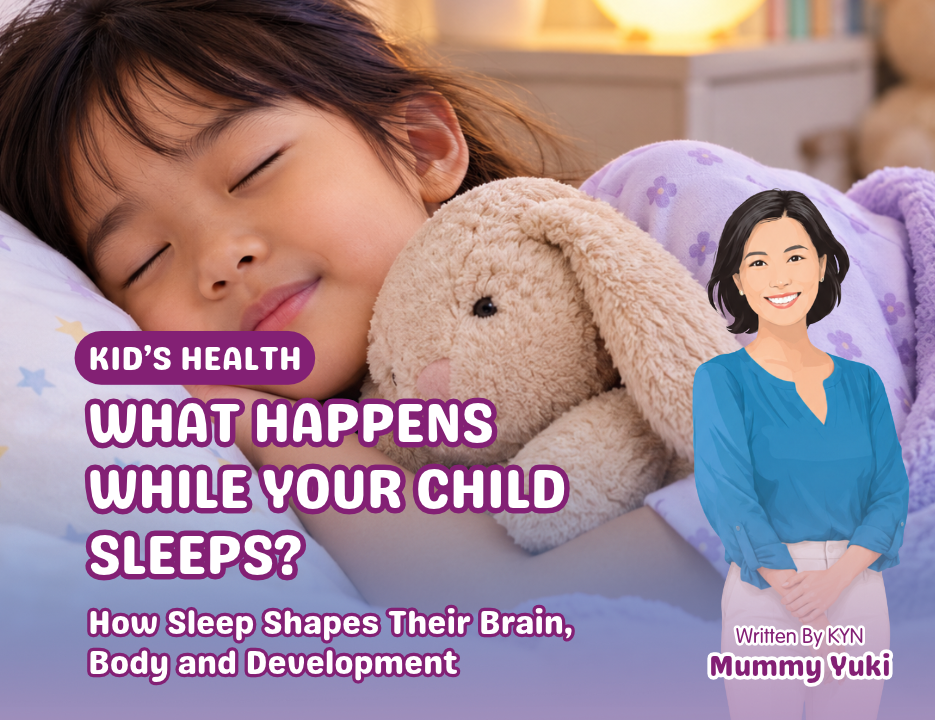
Sleep Is Doing More for Your Child Than You Think
Getting children to bed can sometimes feel like a parenting marathon.
There is the request for one more story, one more glass of water, another trip to the toilet and, somehow, another reason why they are not ready to sleep.
For many families, especially those with school-going children, bedtime can also be a negotiation between homework, enrichment classes, dinner and screen time.
But what if we looked at sleep differently?
Sleep is not simply the time when children stop playing, learning and moving. It is an important part of how they grow, develop and process everything that happens during the day.
While your child is sleeping, their brain is processing information, memories are being consolidated, the body is supporting physical growth and important systems involved in health and metabolism are being regulated.
In other words, some of your child’s most important developmental work happens when they are fast asleep.
And research increasingly suggests that regularly missing out on sufficient sleep may affect much more than just their energy levels the following morning.
Here is what parents should know.
1. Sleep Helps Build Your Child’s Developing Brain
Children learn an incredible amount every day.
From picking up new words and recognising faces to solving problems, understanding instructions and learning new skills, their brains are constantly processing information.
But learning does not stop when the school bell rings.
Sleep plays an important role in helping the brain organise and consolidate what children have learnt throughout the day.
During sleep, the brain strengthens certain neural connections and processes newly acquired information. This helps children retain memories and retrieve information when they need it.
Think about your child learning a new word, practising a piano piece or understanding a mathematical concept.
They need time to learn the information, but they also need sufficient sleep for the brain to process and consolidate that learning.
Research has consistently linked adequate sleep with better attention, memory, learning and cognitive performance in children.
A 2025 systematic review examining studies involving children aged 6 to 12 found consistent associations between better sleep and stronger cognitive performance.
This is particularly relevant for school-going children. When children regularly sleep too little, they may struggle to concentrate, follow instructions and retain what they have learnt.
Sometimes, the problem may not be that a child needs more tuition or another round of revision. They may simply need more sleep.
2. Sleep Affects Your Child’s Mood and Emotional Regulation
Have you noticed how much harder it is for your child to manage their emotions when they are tired?
A small disagreement becomes a big meltdown. They become more impatient, easily frustrated or unusually emotional.
While every child has difficult days, insufficient sleep can make emotional regulation more challenging.
Sleep supports the brain regions involved in processing emotions, responding to stress and controlling impulses.
When children are well-rested, they are generally better equipped to manage frustration, cope with everyday challenges and regulate their behaviour.
On the other hand, inadequate sleep has been associated with:
-
Increased irritability and mood swings.
-
Greater impulsivity and difficulty controlling reactions.
-
More behavioural difficulties.
-
Higher levels of anxiety and depressive symptoms.
A 2025 systematic review of children’s sleep and development found consistent associations between sleep quality and emotional well-being, as well as fewer behavioural difficulties.
This is an important reminder for parents.
When a child is constantly cranky, easily overwhelmed or struggling to manage their emotions, it may be worth looking beyond their behaviour and considering whether they are getting enough quality sleep.
It does not mean every tantrum is caused by tiredness. But sleep is one factor worth paying attention to.
3. Sleep Supports Physical Growth and Development
Children seem to grow overnight, and there is actually a reason why sleep is closely linked to physical growth.
Growth hormone, which plays an important role in bone and muscle development, is released in pulses, with a significant amount released during deep sleep.
This is one reason why sufficient sleep matters during childhood, when the body is undergoing rapid physical development.
Sleep also supports the body’s recovery and repair processes, helping children recover from the physical demands of everyday activities.
Whether your child spends the day running around the playground, attending swimming lessons or simply exploring the world, their bodies need adequate rest to recover.
It is not just about growing taller. Healthy sleep supports the overall development and functioning of the body.
4. Sleep Is Linked to Metabolism and Childhood Obesity
This is an area that deserves more attention, particularly as childhood obesity becomes an increasing concern.
Sleep influences the body’s metabolic processes and appetite regulation.
When children consistently get insufficient sleep, research has linked this to changes in appetite, increased snacking, greater energy intake and a higher risk of unhealthy weight gain.
Interestingly, a Singapore study has provided some particularly relevant findings.
Researchers from the Agency for Science, Technology and Research (A*STAR) examined 638 children from the Growing Up in Singapore Towards healthy Outcomes (GUSTO) cohort, with an average age of 10.2 years.
Using sleep information, activity trackers and MRI scans, researchers investigated the relationship between children’s sleep patterns and body fat.
The findings were noteworthy.
Boys who consistently slept at least nine hours throughout the week had a 51% lower risk of obesity compared with boys who did not get sufficient sleep.
They also had significantly less abdominal fat, including fat around internal organs.
Interestingly, the researchers found that weekend catch-up sleep alone did not show the same protective association.
Similar, although weaker, associations were observed in girls.
This is an important finding for Singapore parents, where school schedules, enrichment classes and homework can sometimes push bedtime later.
It suggests that getting enough sleep consistently throughout the week may matter more than simply allowing children to sleep longer on Saturday and Sunday.
It is worth noting that this was an observational study. It found an association between sleep and obesity risk, rather than proving that sleeping longer directly prevents obesity.
Nevertheless, it adds to the growing evidence that sleep is an important part of children’s physical health.
5. Sleep Helps Support the Immune System
We often focus on nutrition, vitamins and healthy eating when thinking about how to support our children’s immunity.
But sleep deserves a place in that conversation too.
During sleep, the body carries out important processes involved in immune regulation and recovery.
Adequate sleep supports the immune system as it responds to infections and helps maintain the body’s natural defences.
When children regularly miss out on sufficient sleep, these processes may be affected.
Of course, getting enough sleep does not mean your child will never catch a cold. Children are still exposed to viruses, especially when attending childcare and school.
However, sleep is one of the everyday habits that supports overall immune health.
Alongside a balanced diet, physical activity and good hygiene, making sure children get sufficient rest is another way parents can support their well-being.
6. Sleep Affects Attention, Behaviour and School Readiness
One interesting thing about sleep deprivation in children is that it does not always look like sleepiness.
Adults who are tired may become quiet, sluggish or visibly exhausted.
Children, however, can sometimes become more restless, hyperactive, impulsive or easily distracted when they have not had enough sleep.
This can make it harder for them to sit through lessons, follow instructions, complete tasks and interact positively with others.
For younger children, sufficient sleep is also important for developing the attention and self-regulation skills needed for school readiness.
For older children, it supports concentration, problem-solving and the ability to manage academic demands.
This is why sleep should be considered alongside learning and enrichment.
We spend so much time thinking about what our children should learn during the day. But giving them enough time to sleep is also part of helping them learn well.
How Much Sleep Does Your Child Actually Need?
Sleep requirements change as children grow.
The following daily recommendations are based on Singapore’s Health Promotion Board and HealthHub guidance.
| Age | Recommended sleep per day |
|---|---|
| Newborns (0–3 months) | 14–17 hours |
| Infants (4–11 months) | 12–15 hours |
| Toddlers (1–2 years) | 11–14 hours |
| Preschoolers (3–5 years) | 10–13 hours |
| School-going children (6–12 years) | 9–11 hours |
| Teenagers (14–17 years) | 8–10 hours |
For infants and younger children, this includes daytime naps.
These are general guidelines rather than strict targets. Individual sleep needs can vary, and the quality and consistency of sleep matter too.
One thing worth noting is that Singapore’s HealthHub reports that 65% of school-age children are not getting the recommended 9 to 11 hours of sleep each night.
That means many children may be starting their school day without getting the rest their growing bodies and developing brains need.
5 Practical Ways to Help Your Child Sleep Better
Knowing that sleep matters is one thing. Getting children to bed on time is another!
Here are some practical ways to build healthier sleep habits at home.
1. Establish a consistent bedtime
Children benefit from having a predictable sleep schedule.
Try to keep bedtime and wake-up times relatively consistent, including weekends and school holidays. This helps establish a regular sleep-wake rhythm.
2. Create a wind-down routine
Rather than expecting children to switch from energetic play to sleep immediately, give them time to settle down.
A simple routine could include taking a bath, brushing their teeth, reading a story and having a little cuddle before bed.
The routine does not have to be complicated. Consistency is more important.
3. Reduce screen time before bedtime
Tablets, phones and televisions can make it harder for children to settle down, especially when they are watching stimulating content.
Try introducing screen-free time at least an hour before bedtime.
Replace it with quieter activities such as reading, drawing or talking about their day.
4. Make sure bedtime fits their daily schedule
Sometimes, children simply have too much packed into their day.
Between school, enrichment classes, homework, outdoor activities and family commitments, bedtime can easily get pushed back.
Look at your child’s overall schedule and consider whether they have enough time to wind down and sleep.
5. Create a comfortable sleep environment
A quiet, dark and comfortable bedroom can help children settle more easily.
Keep the room cool, reduce unnecessary noise and try to make their sleeping space a place associated with rest.
If your child regularly snores loudly, has pauses in breathing, struggles to fall asleep or remains unusually tired during the day despite sufficient time in bed, speak to a healthcare professional. These may be signs of an underlying sleep problem.
Sleep Is Part of Growing Up Healthy
As parents, we spend so much time thinking about what our children eat, how much they exercise, what they learn and which activities will help them develop.
But perhaps one of the most important things we can give them is something much simpler: enough time to sleep.
Sleep supports their developing brains, helps them manage emotions, contributes to physical growth and plays a role in their long-term health.
And while we cannot control every aspect of our children’s development, we can create an environment that gives them the opportunity to rest well.
So the next time your child asks for one more episode, one more game or just five more minutes before bedtime, remember that those hours of sleep are doing far more than keeping them rested.
They are helping build the foundation for a healthier, happier and more capable child.
Sometimes, the best thing we can do for our children’s development is to let them sleep.
Hello! I am Mummy Yuki

I am one of the editors of KidYouNot team! As a WFH mum, I love quiet mornings, soft music, and messy play is my kind of vibe. I’m all about slow parenting, art time, and letting kids be kids.
Join KidYouNot SG Parenting Community
Sign up to become a member and gain access to exclusive parenting tips, special deals, and early updates on new products and events.
Follow us on Instagram and Telegram to connect with other parents, share your journey, and enjoy fun, supportive content every day!