Can Violence Ever Be Justified to Protect Your Child? What Parents Can Learn From the Roxy Square Incident

Violence Ever Be Justified to Protect Your Child

Can We Use Violence to Right a Wrong?

The recent incident at Roxy Square has been difficult to ignore.

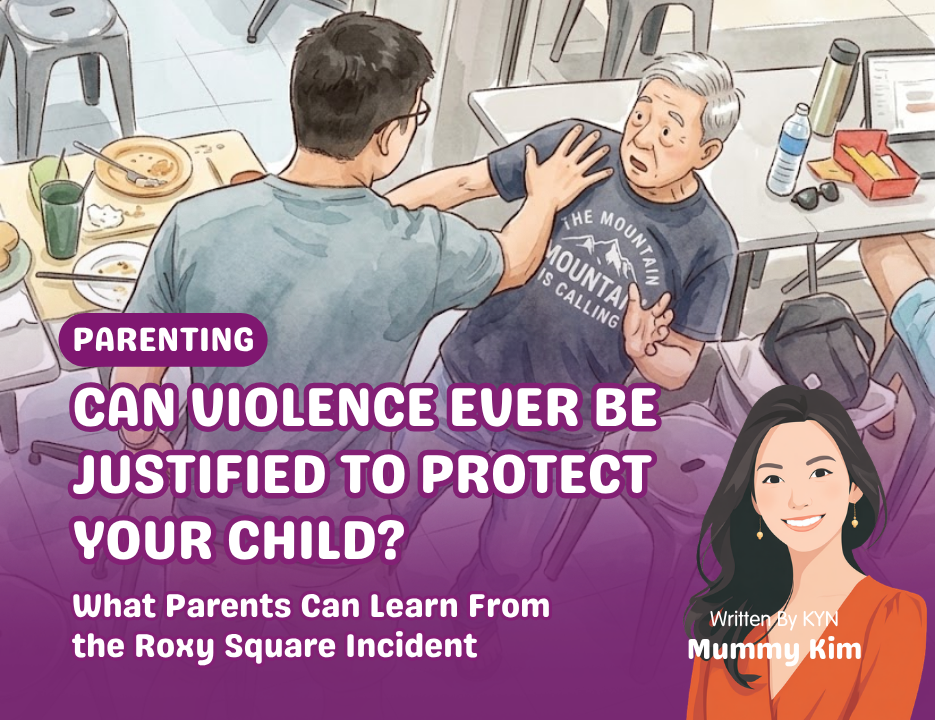
A 73-year-old man was allegedly shoved to the ground after patting a young girl’s head. The incident has since triggered a familiar kind of online debate: some people see a father protecting his daughter, while others see an act of violence against an elderly man.

The police have identified the man involved and investigations are ongoing, so there is still much we do not know about what happened in those few moments.

But as a parent, I find myself less interested in deciding who was right or wrong than in asking a more uncomfortable question:

What do we teach our children about responding when someone does something wrong to them?

Because this is where parenting gets complicated.

We spend years telling our children that hitting is not an acceptable way to solve a problem. When another child grabs a toy, pushes them or hurts them, we tell them to use their words, seek help and walk away rather than retaliate.

Then one day, someone crosses a line with our child.

And suddenly, the calm parenting advice can feel much harder to follow.

The instinct to protect is real

I can understand why a parent might react strongly if a stranger touches their child.

For some families, a pat on the head may seem completely harmless. For others, it may feel like an invasion of a child’s personal space. Children should certainly learn that they have a say over who touches them, and parents have every reason to step in when they feel their child’s boundaries have been crossed.

If that was what the father was trying to communicate, the intention is understandable.

But intention and action are not necessarily the same thing.

There is a difference between telling someone, firmly, not to touch your child and physically hurting them because you are angry about what they have done.

That distinction matters, especially when our children are watching.

Our children are learning from the moments we lose our temper

This is probably the part that makes me uncomfortable.

When we talk about modelling behaviour for our children, we tend to think about the obvious things: saying please and thank you, sharing, apologising, being kind.

But children are also watching what happens when we are furious.

They see how we react when someone cuts in front of us in traffic. They hear how we speak about someone who has upset us. They notice what happens when another child takes their toy or when an adult behaves badly.

And they are particularly likely to remember what we do when we are angry on their behalf.

A child may not understand all the circumstances surrounding an altercation. They may simply see that someone crossed a boundary and an adult responded with physical force.

That raises an uncomfortable possibility: are we teaching our children that violence is wrong, or that violence is acceptable when we believe we are justified?

But protecting our children does not mean standing by

There is a danger, too, in taking the argument too far.

Choosing not to respond violently does not mean parents should tolerate inappropriate behaviour towards their children.

Quite the opposite.

Children need adults who will notice when something is wrong and step in. They need to know that their discomfort matters and that they can tell us when someone has made them uncomfortable.

There is nothing wrong with being angry when someone crosses a boundary involving our child. Anger can be useful. It tells us that something matters.

The challenge is what we do with that anger.

Because once we move from stopping a situation to hurting someone in retaliation, we are no longer simply protecting our child. We are making another choice, one that carries consequences of its own.

This is where the phrase “righting a wrong” becomes dangerous

We often justify our actions by the reason behind them.

They started it.

They shouldn’t have touched my child.

They deserved it.

They needed to learn a lesson.

But if we allow ourselves to decide that another person’s wrongdoing gives us permission to hurt them, where does that reasoning stop?

The original act may have been inappropriate. It may have been insensitive. It may even have been frightening.

But does that make every response to it acceptable?

I don’t think it does.

And that is not because I believe parents should be passive. It is because I don’t want my child to grow up believing that being right gives us permission to do wrong.

What would I want my child to do?

This is probably the question I would rather ask myself.

If another child pushed my son, I wouldn’t want him to push back simply because he was angry.

If someone said something cruel to him, I wouldn’t want him to hurt them because they “deserved it”.

If someone crossed his physical boundaries, I would want him to know that he can say no, move away and find an adult who can help.

And if someone genuinely threatened his safety, I would want him to know the difference between protecting himself and taking revenge.

Perhaps that is the distinction we need to make as parents too.

Self-defence and retaliation are not the same thing.

Protecting someone from immediate harm is different from hurting someone because we believe they deserve it.

The hardest part may be controlling ourselves

Parenting often asks us to teach lessons that we are still learning ourselves.

We tell our children to take a breath when they are angry, while sometimes struggling to take one ourselves.

We tell them not to hit when they are frustrated, while knowing how difficult it can be to stay composed when someone has upset our child.

And perhaps that is why incidents like this hit such a nerve.

Most parents probably recognise the feeling, even if they would not respond in the same way.

That surge of anger when you think someone has treated your child badly.

The instinct to step in.

The feeling that, How dare you?

That instinct isn’t something we need to be ashamed of. It is part of being a parent.

But perhaps being a good parent means learning not to let that instinct make every decision for us.

Because one day, our children will face these situations without us

We won’t always be there to speak for them.

They will have disagreements at school. They will encounter people who are rude, insensitive or unfair. Someone will hurt their feelings. Someone may cross a boundary.

We cannot protect them from every difficult interaction.

What we can do is give them a framework for dealing with those moments.

I want my child to know that he is allowed to stand up for himself. I want him to know that his body belongs to him and that he doesn’t have to accept behaviour that makes him uncomfortable.

But I also want him to understand that another person’s bad behaviour does not automatically give him permission to hurt them.

Because ultimately, that is the lesson behind all of this.

We teach our children that hitting is not how we solve problems. Perhaps we need to hold ourselves to the same standard, especially when we are angry enough to think we are justified.

The Roxy Square incident may eventually be resolved by the authorities, and the full circumstances may become clearer.

For parents, though, there is another conversation worth having – what happens when our protective instinct collides with our responsibility to model the behaviour we expect from our children.

Because when our children are watching, how we respond to a wrong may become a bigger lesson than the wrong itself.


Hello! I am Mummy Kim!

KidYouNot Editor Mummy Kim

A beauty-loving mum who believes that looking good and feeling good go hand in hand. My parenting mantra is raising happy, confident kids with strong self-esteem! Between facial masks and storybooks, I’m all about nurturing both inner and outer beauty, for myself and my little ones.


Join KidYouNot SG Parenting Community

Sign up to become a member and gain access to exclusive parenting tips, special deals, and early updates on new products and events.

Follow us on Instagram and Telegram to connect with other parents, share your journey, and enjoy fun, supportive content every day!


 

Related Posts

0

Or Sign In using

[xs_social_login]

Don’t have an account yet ? Sign Up Now

Terms & Condtions (LASH INC. GIVEAWAY)

YOU AGREE that Kidyounot.sg, a platform operated by Next Chapter Media Pte Ltd, its subsidiaries, partners, and affiliates (collectively “we”, “our”, or “us”), may collect, use, and disclose your personal data for the following purposes:

  • To provide you with products, services, and fulfil giveaway participation;
  • For consumer research, promotional, and marketing purposes;
  • To verify your eligibility for campaigns, promotions, or contests;
  • To provide you with the benefits of any membership, campaign, or contest you participate in.


We may share your personal data within our organisation and with third parties supporting our marketing, logistics, customer service, business development, and campaign fulfilment functions. This may include storing, using, or transferring your data outside of Singapore. We may also share your personal data for joint-marketing and cross-promotional efforts.

To qualify for redemption, participants must meet the following criteria:

To qualify for the Lash Inc. Giveaway and cash voucher rewards, participants must:

  • Be at least 21 years old and currently residing in Singapore.
  • Provide consent to receive promotional and marketing materials from Kidyounot.sg, Next Chapter Media Pte Ltdand their affiliated partners.
  • Not be an appointed Financial Adviser Representative nor have an immediate family (spouse) who is currently appointed as one.
  • Provide a valid local mobile number and email address.
  • Agree to a no-obligation financial consultation with a licensed representative from Xchange Branch, a branch of Infinitum Financial Advisory Pte. Ltd. (trading under the name and style of “Income Advisory Financial Advisers” (“IAFA”)).
  • Grand Prize: One participant will win a $500 Lash Inc. voucher.
  • Bonus Vouchers: Participants who complete a consultation will receive a $50 Lash Inc. voucher (limited to one voucher per participant).


Participants who complete a financial consultation will receive one additional entry into the grand prize draw.

  • The lucky draw will commence once 50 valid sign-upsare received, or by 31st August 2025, whichever occurs first.
  • The winner will be selected at random and announced within 7 days of the draw on kidyounot.sg’s Instagram page (@kidyounot.sg).
  • All vouchers are non-transferable, non-exchangeable for cash, and valid only for use at Lash Inc.
  • Vouchers are issued on an “as-is” basis and will not be reissued or replaced if lost or expired.
  • Redemption is subject to Lash Inc.’s appointment availability and terms of service.

Kidyounot.sg and Next Chapter Media reserve the right to:

  • Modify, postpone, or cancel the giveaway or any of its components at any time without prior notice.
  • Substitute the giveaway items with items of similar or equal value, depending on availability.


All decisions made by the organisers regarding the giveaway are final and binding.

To the maximum extent permitted by law, Kidyounot.sg, Next Chapter Media, IAFA, and its authorised representatives shall not be held liable for any loss, injury, claim, or damage arising from this giveaway or its associated products. Participants agree to release and indemnify all mentioned parties from any claims, damages, or liabilities arising from:

  • Personal injury, death, or disability;
  • Property loss or damage;
  • Misuse or misunderstanding of products and services provided.


This giveaway is governed by the laws of Singapore, and all participants agree to submit to the exclusive jurisdiction of the Singapore courts.

Rewards terms & condition

Disclaimer:

The Kidyounot Rewards Program (“Program”) is designed to reward users for their engagement on our platform. Points earned through various activities are non-transferable, have no cash value, and can only be redeemed in accordance with the terms outlined below. Kidyounot.sg reserves the right to modify, suspend, or terminate the Program at any time without prior notice.

  • The Program is open to all registered users of Kidyounot.sg with an active account in good standing.
  • Points can be earned and redeemed as outlined on Kidyounot.sg.
  • Redemption options are subject to availability and may change without notice.
  • Points are valid for a specified period from the date they are earned. Expired points will be automatically forfeited without notice.
  • Points are non-transferable and cannot be exchanged for cash or combined with other accounts.
  • If a user’s account is terminated for any reason, all unused points will be forfeited.
  • Kidyounot.sg reserves the right to revoke points or suspend accounts found engaging in fraudulent or abusive activities.
  • Kidyounot.sg reserves the right to amend, suspend, or terminate the Program at any time without prior notice. Continued participation constitutes acceptance of the revised terms.
  • Kidyounot.sg is not responsible for any loss, theft, or unauthorised use of points.
  • We disclaim all warranties related to the Program.
  • These Terms and Conditions are governed by the laws of [Insert Country/Region].

By submitting this application form, you consent to the collection, use, and disclosure of your personal data by Kidyounot.sg for the following purposes:

be a tester terms & condition

You may withdraw your consent at any time by contacting our Data Protection Officer. However, doing so may limit your ability to access certain products or services provided by us.

  • Applicants must be at least 21 years old and reside in Singapore.
  • Only parents or guardians with caregiving responsibilities are eligible to apply.
  • Submission of the application form does not guarantee selection.
  • Kidyounot.sg reserves the right to shortlist candidates based on product suitability and internal criteria.
  • Selected testers will receive products within 5-7 working days after confirmation.
  • Testers are required to test the product and submit an honest, detailed review within 30 days of receiving the product.
  • Reviews should reflect genuine experiences without any false or misleading information.
  • Reviews may be edited for clarity or grammar but not for content.
  • By submitting a review, you grant Kidyounot.sg the right to use, reproduce, and publish your review for marketing, promotional, or commercial purposes without additional compensation.
  • Failure to submit a review within the stipulated timeframe may result in disqualification from future campaigns.
  • Misuse of products or submission of fraudulent reviews will result in immediate disqualification.
  • Kidyounot.sg is not responsible for any adverse effects or damages resulting from the use of the tested products.
  • Products are provided “as-is,” and any claims should be directed to the respective product manufacturer.

Personal Data Protection Act (PDPA) Clause

By submitting this application form, you consent to the collection, use, and disclosure of your personal data by Kidyounot.sg for the following purposes:

  • To process your application for the “Tried & Tested” program.
  • To contact you regarding product testing opportunities, feedback, and related communications.
  • To deliver products to your provided address.
  • Your personal data may be shared with third-party vendors, including brands supplying the products, solely for the purpose of product fulfillment and follow-up communication.
  • We will take reasonable measures to protect your data from unauthorized access, collection, use, or disclosure.
  • You may withdraw your consent at any time by contacting us at [Insert Contact Information].
  • Please note that withdrawing consent may affect your participation in the program.