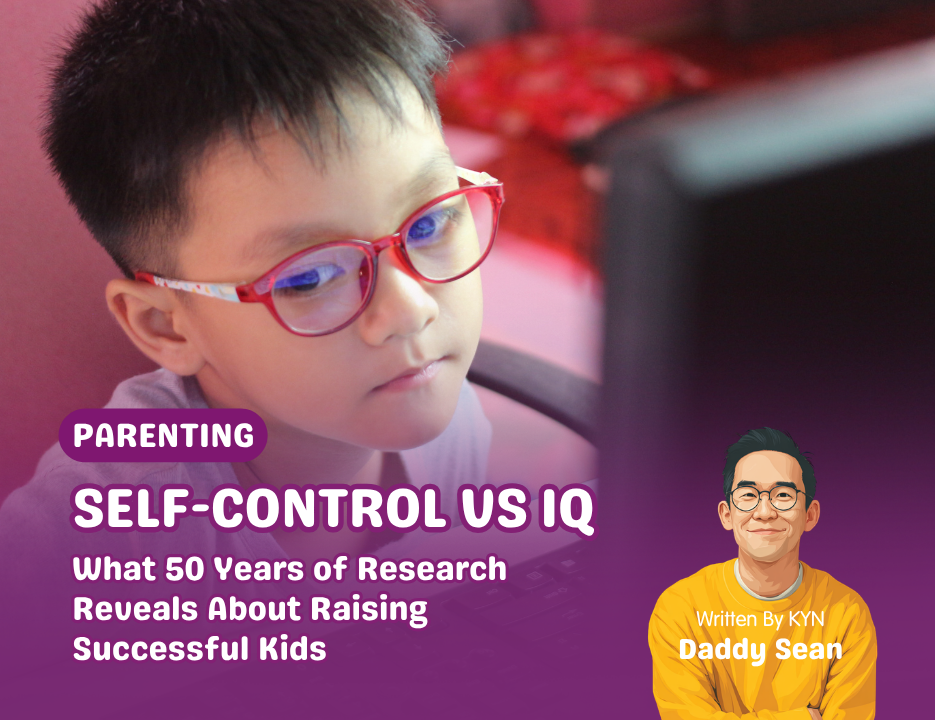
Scientists tracked 1,037 children for over 50 years and found one of the strongest predictors of success wasn’t IQ.
Quick answer: In the landmark Dunedin Multidisciplinary Study, researchers followed 1,037 New Zealand children from birth into their 50s. Self-control, the ability to stay focused, manage frustration, and persevere, predicted adult outcomes in health, finances, and relationships even more consistently than IQ. Unlike IQ, self-control can be taught, which means parents in Singapore (and everywhere else) have real influence over it.
As parents, we all wonder the same thing: what will actually help our children succeed in life?
Straight As? A high IQ? Early reading? The “right” enrichment classes?
For decades, many of us believed academic intelligence was the biggest predictor of future success. One of the world’s most influential child development studies suggests there’s something even more important.
What Is the Dunedin Study?
In the early 1970s, researchers in New Zealand began following 1,037 children born in Dunedin. What started as a childhood health study became one of the world’s longest-running research projects, tracking participants from birth into adulthood for more than 50 years.
The researchers didn’t just look at school grades. They followed every aspect of life, education, careers, physical and mental health, relationships, finances, and overall wellbeing.
Their central question: what actually predicts a child’s future success?
Does IQ Matter for Success?
IQ matters, there’s no doubt about that. Children with higher cognitive abilities often find academic learning easier and may perform better in school.
But when researchers looked at life outcomes decades later, IQ wasn’t the whole story. Another trait consistently stood out: self-control.
Children who showed stronger self-control in childhood were more likely to experience positive outcomes as adults, even after researchers accounted for differences in IQ and family background.
What Is Self-Control, Exactly?
When we hear “self-control,” we often picture a child sitting quietly or following instructions. But the researchers meant something much broader. Self-control includes the ability to:
- Stay focused on a task
- Think before acting
- Manage frustration
- Resist impulsive decisions
- Persevere when something feels difficult
- Recover after setbacks
In today’s language, many of these fall under executive function and emotional regulation, skills that help children navigate everyday challenges, both inside and outside the classroom.
Why Does Self-Control Matter So Much?
Life isn’t a series of multiple-choice questions. Success depends on much more than knowing the right answer.
- Children who learn to manage their emotions are better equipped to handle disappointment.
- Children who can stay focused are more likely to complete challenging tasks.
- Children who keep trying after mistakes are often the ones who keep learning and growing.
These qualities don’t just help in school. They help throughout life.
Can Self-Control Be Taught?
Here’s the part every parent needs to hear: unlike IQ, self-control isn’t something children are simply born with. It develops over time, through everyday experience.
- When they learn to wait their turn.
- When they work through a puzzle instead of giving up.
- When they calm themselves after feeling upset.
- When they’re encouraged to solve small problems instead of having every obstacle removed for them.
These moments may seem ordinary, but they’re building skills that last a lifetime.
5 Everyday Ways to Build Self-Control at Home
You don’t need expensive programmes or endless worksheets. Often, the most powerful opportunities happen at home.
1. Let them struggle a little. It’s natural to want to step in immediately. But giving children time to think, problem-solve, and try again builds confidence and persistence.
2. Teach emotions, not just behaviour. Instead of saying “stop crying,” help them name what they’re feeling. Children who understand their emotions gradually learn how to manage them.
3. Create predictable routines. Simple routines around meals, homework, and bedtime help children develop planning and self-regulation.
4. Praise effort instead of only results. Celebrate persistence. Celebrate improvement. Celebrate trying again. These messages teach children that growth matters more than perfection.
5. Be the model. Children learn self-control by watching us. When we stay calm, apologise after losing our temper, or work through challenges patiently, we’re teaching them far more than words ever could.
Success Is Bigger Than Grades
This doesn’t mean grades don’t matter, academic learning opens doors and provides important opportunities. But success in life isn’t determined by report cards alone.
The ability to adapt. To persevere. To regulate emotions. To make thoughtful decisions. To keep learning when things get difficult. These are the qualities that will keep serving our children long after they’ve forgotten what came up in their spelling test.
A Final Thought
As another school term begins, it’s easy to focus on marks, rankings, and academic progress. Those things have their place.
But it’s worth asking a second question, not just “Is my child smart enough?” but “Am I helping my child develop the skills that will help them thrive for life?”
Because one day, no one will remember a Primary 3 spelling score. But your child’s resilience, self-control, confidence, and ability to keep going through life’s challenges may shape their future for decades to come.
Hello! I am Daddy Sean

I am one of the editors of KidYouNot Parenting blogs! I have two adorable sons. I’m a nature lover who values wellbeing and mindful parenting. I’m all about creating balance, connection, and joy in family life.
Join KidYouNot SG Parenting Community
Sign up to become a member and gain access to exclusive parenting tips, special deals, and early updates on new products and events.
Follow us on Instagram and Telegram to connect with other parents, share your journey, and enjoy fun, supportive content every day!