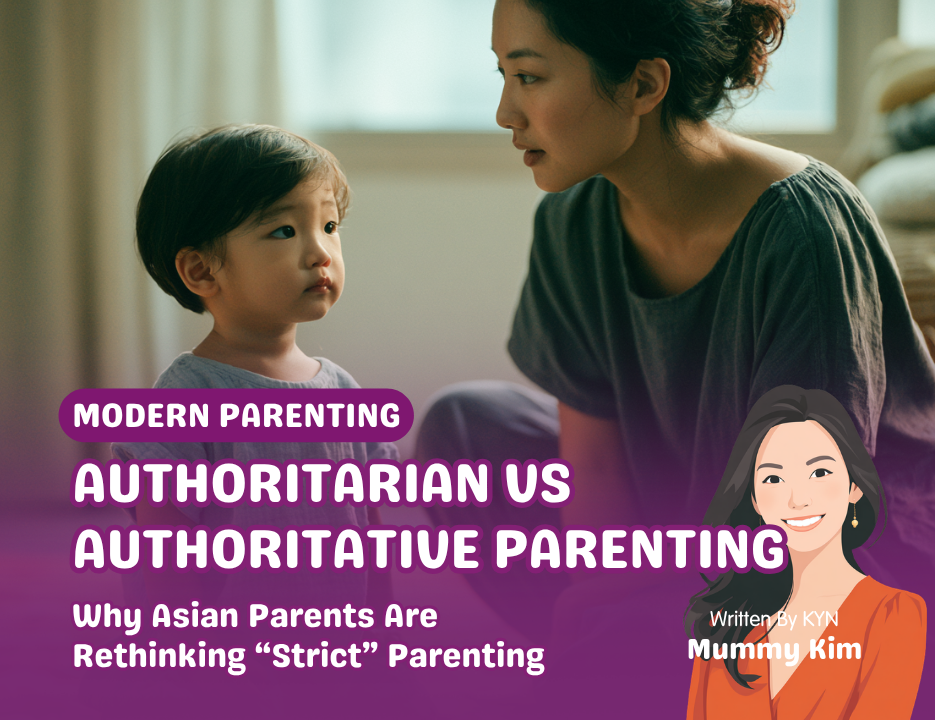
Authoritarian vs Authoritative Parenting: Why Asian Parents Are Rethinking “Strict” Parenting

Authoritarian vs Authoritative Parenting: Why Asian Parents Are Rethinking “Strict” Parenting

For generations, strict parenting has been deeply woven into many Asian households.

Children were taught to obey elders, prioritise academic success, and avoid bringing shame to the family.

Discipline was often seen as a reflection of love and responsibility. In Singapore especially, where competition and academic pressure remain intense, many parents believed that being strict was necessary for children to succeed.

But younger parents today are beginning to challenge that mindset.

As conversations around emotional wellbeing, childhood development, and mental health become more common, many Singaporean parents are asking an important question: Is fear-based parenting actually helping children in the long run?

This shift has brought greater attention to two parenting styles often misunderstood or confused with one another: authoritarian parenting and authoritative parenting.

The Parenting Style Many Asians Grew Up With

Authoritarian parenting is commonly associated with traditional strict parenting.

This style focuses heavily on obedience, rules, discipline, and parental authority. Children are expected to listen without questioning, while emotional expression is often discouraged or viewed as disrespectful.

Common phrases associated with authoritarian parenting include:

  • “Because I said so.”
  • “Don’t talk back.”
  • “Stop crying.”
  • “You should know better.”

In many Asian families, this approach was not necessarily rooted in cruelty, but in survival, fear, and protection.

Parents who lived through financial hardship or instability often believed strict discipline would prepare children for a competitive world. Good grades, stable careers, and strong obedience were viewed as pathways to security and social mobility.

Singapore’s highly competitive education system further reinforced these parenting patterns. Many parents worried that being too lenient would lead children to become unmotivated or unable to cope with pressure.

While authoritarian parenting can produce disciplined and academically driven children, experts have increasingly pointed to its emotional consequences.

Children raised in highly authoritarian environments may become:

  • Fearful of failure
  • Emotionally withdrawn
  • Highly anxious
  • Dependent on external validation
  • Uncomfortable expressing emotions openly

Some adults raised this way later struggle with confidence, communication, or emotional intimacy, particularly within family relationships.

The Rise of Authoritative Parenting

In contrast, authoritative parenting combines structure with emotional connection.

This parenting style still includes boundaries, rules, and discipline, but places greater emphasis on communication, emotional safety, and mutual respect.

An authoritative parent may acknowledge a child’s emotions while still maintaining limits. Instead of shutting emotions down immediately, the parent guides the child through them.

For example:
“I understand you’re upset, but hitting is not acceptable.”

The child still learns consequences and boundaries, but without fear becoming the primary teaching tool.

Importantly, authoritative parenting is not permissive parenting. It does not mean allowing children to behave without limits or avoiding discipline altogether.

Rather, it focuses on helping children understand behaviour, develop emotional regulation, and build trust with caregivers.

Research over the years has consistently linked authoritative parenting with:

  • Higher self-esteem
  • Better emotional regulation
  • Stronger social skills
  • Greater independence
  • Healthier parent-child relationships

Many psychologists consider it one of the most balanced parenting approaches for long-term emotional development.

Why Singapore Parents Are Parenting Differently Today

A growing number of millennial and younger parents in Singapore are consciously trying to break cycles they experienced growing up.

Parenting content on social media, mental health awareness, and increased access to child development information have all contributed to this shift. Conversations around gentle parenting, nervous system regulation, attachment theory, and childhood trauma are becoming increasingly mainstream.

Many parents now recognise that children’s emotional wellbeing is just as important as academic performance.

This does not mean parents are abandoning discipline altogether. Instead, many are searching for ways to raise respectful children without relying primarily on fear, shame, or emotional suppression.

The pandemic years also accelerated these conversations. Spending extended time at home led many parents to reflect more deeply on family relationships, emotional stress, and communication patterns within the household.

The Cultural Tension Modern Asian Parents Face

Despite this shift, parenting differently is not always easy within Asian family structures.

Many Singapore parents still face pressure from older generations who may view softer communication styles as ineffective or overly indulgent.

Comments such as:

  • “Kids nowadays are too pampered.”
  • “Last time our parents used the cane.”
  • “Why are you negotiating with your child?”

remain common in many households.

This creates tension for parents attempting to balance traditional values such as respect and discipline with newer understandings of emotional health and child psychology.

The challenge is not simply choosing between being “strict” or “soft.” For many parents, it is about finding a sustainable balance between authority, guidance, emotional connection, and cultural expectations.

Parenting Beyond Fear

Experts increasingly agree that children learn best when they feel emotionally safe.

Fear may create short-term obedience, but emotional security often builds stronger long-term trust, resilience, and communication.

Children who feel heard and respected are generally more willing to cooperate, express emotions safely, and seek support when needed.

At the same time, parenting experts emphasise that no parent follows one parenting style perfectly all the time. Stress, work demands, financial pressure, and exhaustion can affect even the most intentional parents.

The goal is not perfection, but awareness.

For many Asian parents today, the conversation is no longer simply about raising successful children. It is increasingly about raising emotionally secure ones as well.


Hello! I am Mummy Kim!

KidYouNot Editor Mummy Kim

A beauty-loving mum who believes that looking good and feeling good go hand in hand. My parenting mantra is raising happy, confident kids with strong self-esteem! Between facial masks and storybooks, I’m all about nurturing both inner and outer beauty, for myself and my little ones.


Join KidYouNot SG Parenting Community

Sign up to become a member and gain access to exclusive parenting tips, special deals, and early updates on new products and events.

Follow us on Instagram and Telegram to connect with other parents, share your journey, and enjoy fun, supportive content every day!

 

Related Posts

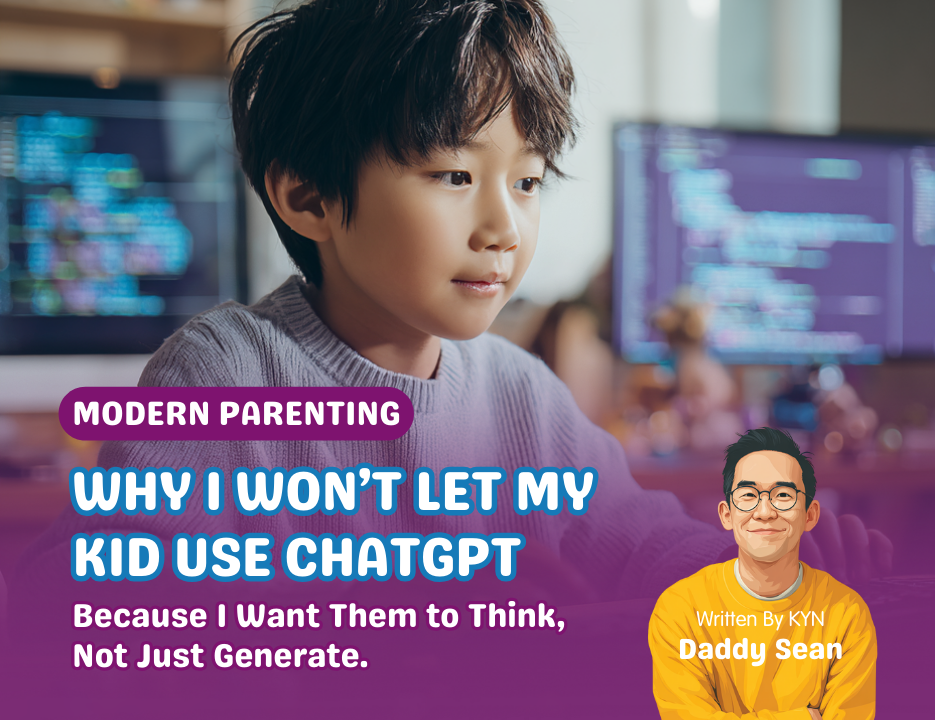
Why I Won’t Let My Kids Use ChatGPT — Coding Matters More

Why I Won’t Let My Kids Use ChatGPT Until They Learn to Think for Themselves

As AI tools like ChatGPT become part of everyday life, many parents wonder if their kids should start using them early. I’m taking the opposite approach. I’m holding off on ChatGPT for now because coding, creativity, and critical thinking build stronger foundations for the future. Kids need to learn how to think before they learn how to use AI.

Learn More

Organic Baby Care: Myths vs. Facts

In recent years, “organic” has become a buzzword in the parenting world. Many parents gravitate towards organic products—foods, clothing, skincare—believing they’re inherently safer or more beneficial for their babies. While organic options can offer advantages, misinformation abounds. Separating fact from fiction ensures that you make informed decisions that truly support

Learn More
0

Or Sign In using

[xs_social_login]

Don’t have an account yet ? Sign Up Now

Terms & Condtions (LASH INC. GIVEAWAY)

YOU AGREE that Kidyounot.sg, a platform operated by Next Chapter Media Pte Ltd, its subsidiaries, partners, and affiliates (collectively “we”, “our”, or “us”), may collect, use, and disclose your personal data for the following purposes:

  • To provide you with products, services, and fulfil giveaway participation;
  • For consumer research, promotional, and marketing purposes;
  • To verify your eligibility for campaigns, promotions, or contests;
  • To provide you with the benefits of any membership, campaign, or contest you participate in.


We may share your personal data within our organisation and with third parties supporting our marketing, logistics, customer service, business development, and campaign fulfilment functions. This may include storing, using, or transferring your data outside of Singapore. We may also share your personal data for joint-marketing and cross-promotional efforts.

To qualify for redemption, participants must meet the following criteria:

To qualify for the Lash Inc. Giveaway and cash voucher rewards, participants must:

  • Be at least 21 years old and currently residing in Singapore.
  • Provide consent to receive promotional and marketing materials from Kidyounot.sg, Next Chapter Media Pte Ltdand their affiliated partners.
  • Not be an appointed Financial Adviser Representative nor have an immediate family (spouse) who is currently appointed as one.
  • Provide a valid local mobile number and email address.
  • Agree to a no-obligation financial consultation with a licensed representative from Xchange Branch, a branch of Infinitum Financial Advisory Pte. Ltd. (trading under the name and style of “Income Advisory Financial Advisers” (“IAFA”)).
  • Grand Prize: One participant will win a $500 Lash Inc. voucher.
  • Bonus Vouchers: Participants who complete a consultation will receive a $50 Lash Inc. voucher (limited to one voucher per participant).


Participants who complete a financial consultation will receive one additional entry into the grand prize draw.

  • The lucky draw will commence once 50 valid sign-upsare received, or by 31st August 2025, whichever occurs first.
  • The winner will be selected at random and announced within 7 days of the draw on kidyounot.sg’s Instagram page (@kidyounot.sg).
  • All vouchers are non-transferable, non-exchangeable for cash, and valid only for use at Lash Inc.
  • Vouchers are issued on an “as-is” basis and will not be reissued or replaced if lost or expired.
  • Redemption is subject to Lash Inc.’s appointment availability and terms of service.

Kidyounot.sg and Next Chapter Media reserve the right to:

  • Modify, postpone, or cancel the giveaway or any of its components at any time without prior notice.
  • Substitute the giveaway items with items of similar or equal value, depending on availability.


All decisions made by the organisers regarding the giveaway are final and binding.

To the maximum extent permitted by law, Kidyounot.sg, Next Chapter Media, IAFA, and its authorised representatives shall not be held liable for any loss, injury, claim, or damage arising from this giveaway or its associated products. Participants agree to release and indemnify all mentioned parties from any claims, damages, or liabilities arising from:

  • Personal injury, death, or disability;
  • Property loss or damage;
  • Misuse or misunderstanding of products and services provided.


This giveaway is governed by the laws of Singapore, and all participants agree to submit to the exclusive jurisdiction of the Singapore courts.

Rewards terms & condition

Disclaimer:

The Kidyounot Rewards Program (“Program”) is designed to reward users for their engagement on our platform. Points earned through various activities are non-transferable, have no cash value, and can only be redeemed in accordance with the terms outlined below. Kidyounot.sg reserves the right to modify, suspend, or terminate the Program at any time without prior notice.

  • The Program is open to all registered users of Kidyounot.sg with an active account in good standing.
  • Points can be earned and redeemed as outlined on Kidyounot.sg.
  • Redemption options are subject to availability and may change without notice.
  • Points are valid for a specified period from the date they are earned. Expired points will be automatically forfeited without notice.
  • Points are non-transferable and cannot be exchanged for cash or combined with other accounts.
  • If a user’s account is terminated for any reason, all unused points will be forfeited.
  • Kidyounot.sg reserves the right to revoke points or suspend accounts found engaging in fraudulent or abusive activities.
  • Kidyounot.sg reserves the right to amend, suspend, or terminate the Program at any time without prior notice. Continued participation constitutes acceptance of the revised terms.
  • Kidyounot.sg is not responsible for any loss, theft, or unauthorised use of points.
  • We disclaim all warranties related to the Program.
  • These Terms and Conditions are governed by the laws of [Insert Country/Region].

By submitting this application form, you consent to the collection, use, and disclosure of your personal data by Kidyounot.sg for the following purposes:

be a tester terms & condition

You may withdraw your consent at any time by contacting our Data Protection Officer. However, doing so may limit your ability to access certain products or services provided by us.

  • Applicants must be at least 21 years old and reside in Singapore.
  • Only parents or guardians with caregiving responsibilities are eligible to apply.
  • Submission of the application form does not guarantee selection.
  • Kidyounot.sg reserves the right to shortlist candidates based on product suitability and internal criteria.
  • Selected testers will receive products within 5-7 working days after confirmation.
  • Testers are required to test the product and submit an honest, detailed review within 30 days of receiving the product.
  • Reviews should reflect genuine experiences without any false or misleading information.
  • Reviews may be edited for clarity or grammar but not for content.
  • By submitting a review, you grant Kidyounot.sg the right to use, reproduce, and publish your review for marketing, promotional, or commercial purposes without additional compensation.
  • Failure to submit a review within the stipulated timeframe may result in disqualification from future campaigns.
  • Misuse of products or submission of fraudulent reviews will result in immediate disqualification.
  • Kidyounot.sg is not responsible for any adverse effects or damages resulting from the use of the tested products.
  • Products are provided “as-is,” and any claims should be directed to the respective product manufacturer.

Personal Data Protection Act (PDPA) Clause

By submitting this application form, you consent to the collection, use, and disclosure of your personal data by Kidyounot.sg for the following purposes:

  • To process your application for the “Tried & Tested” program.
  • To contact you regarding product testing opportunities, feedback, and related communications.
  • To deliver products to your provided address.
  • Your personal data may be shared with third-party vendors, including brands supplying the products, solely for the purpose of product fulfillment and follow-up communication.
  • We will take reasonable measures to protect your data from unauthorized access, collection, use, or disclosure.
  • You may withdraw your consent at any time by contacting us at [Insert Contact Information].
  • Please note that withdrawing consent may affect your participation in the program.