EQ Is Not Something That Starts “Later”
Most of us assume that emotional intelligence, or EQ, is something children develop later in life. We tend to associate it with school-going years, when children begin forming friendships, navigating social situations, and learning how to manage their behaviour. It feels intuitive to think that emotional skills come after cognitive development.
But the reality is far more surprising.
Emotional intelligence does not begin at age five, or even three. It begins from birth.
Psychologist Daniel Goleman, who popularised the concept of emotional intelligence, explains that EQ is not something we explicitly teach like reading or mathematics.
Instead, it is something children absorb through repeated interactions, especially in their earliest years. Research from Harvard University further supports this, showing that early caregiving relationships play a critical role in shaping the brain circuits responsible for emotional regulation, empathy, and stress response.
In other words, long before a child can speak or reason, their emotional world is already being formed.
0–12 Months: Building Emotional Safety
In the first year of life, babies are not capable of understanding emotions in a cognitive sense, but they are highly sensitive to how they feel. Every cry that is responded to, every moment of eye contact, and every soothing touch sends a powerful message about safety and trust.
When caregivers respond consistently and warmly, babies begin to internalise a sense of security. This early emotional safety becomes the foundation upon which all future emotional skills are built.
1–3 Years: Navigating Big Feelings
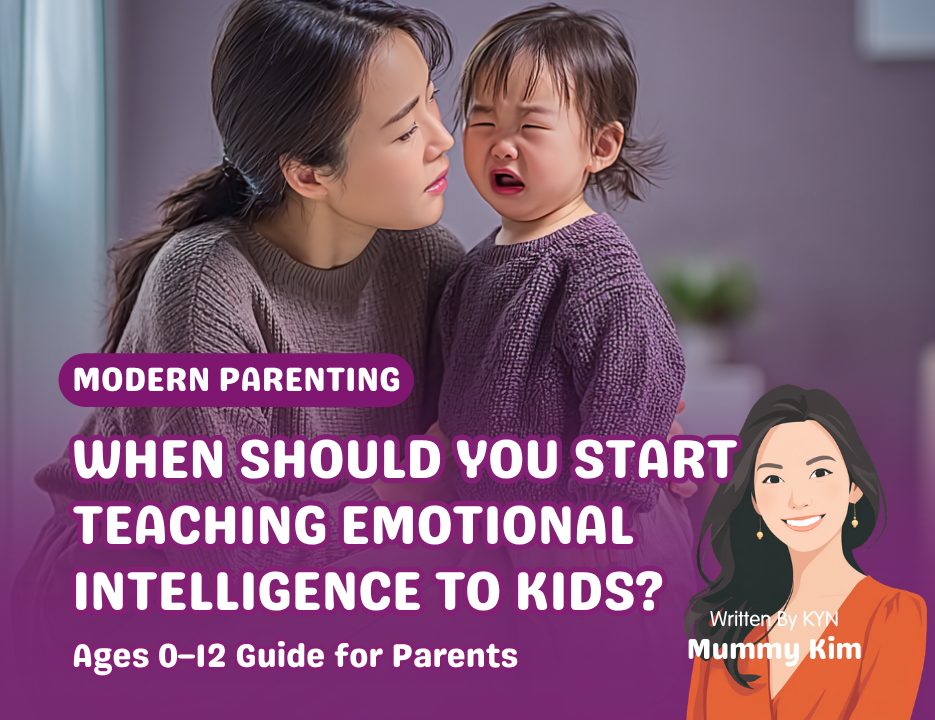
As children move into the toddler years, emotional development becomes more visible, and often more challenging for parents. Toddlers experience intense feelings, yet they lack the language to express them. Tantrums, frustration, and sudden emotional outbursts are not signs of poor behaviour, but rather signs of a developing emotional system.
During this stage, what matters most is not control, but guidance. When parents help label emotions, stay calm in the face of meltdowns, and validate what the child is feeling, they are teaching the child that emotions are understandable and manageable. These small, repeated moments lay the groundwork for emotional awareness.
3–7 Years: Developing Empathy
By the time children reach the preschool years, their emotional world begins to expand beyond themselves. They start to recognise that others have feelings too, marking the early development of empathy.
This is often seen in simple but meaningful behaviours, such as offering comfort to a friend or showing concern when someone is upset. Parents can nurture this by encouraging perspective-taking, asking reflective questions, and modelling kindness in everyday interactions. Emotional intelligence at this stage is no longer just about self-awareness, but about understanding relationships.
7–12 Years: Learning Emotional Regulation
As children grow older and enter their primary school years, emotional intelligence takes on a more complex role. They begin facing real-life challenges such as friendships, peer dynamics, and academic pressures.
At this point, it is not enough for them to simply recognise emotions—they need to manage them. This includes learning how to cope with frustration, resolve conflicts, and reflect on their own behaviour. With guidance, children can develop resilience and self-regulation, skills that will support them far beyond childhood.
The Biggest Misconception About EQ
One of the most common misconceptions about emotional intelligence is the belief that it can be taught later, when children are “ready.” In reality, by the time we think about teaching it, many emotional patterns have already been formed.
Emotional intelligence is not built through occasional lessons or structured activities. It is shaped quietly and consistently through daily interactions.
Children learn emotional intelligence not from what we tell them, but from what they observe. They watch how we respond under stress, how we communicate, and how we handle our own emotions. These everyday moments become their blueprint for understanding the world.
So, When Is the Right Age to Start?
The answer is simple, yet profound: from the very beginning.
Not through formal teaching, but through presence, responsiveness, and the way we connect with our children each day.
In a world where artificial intelligence is rapidly advancing, the qualities that will set our children apart are not purely cognitive. The ability to empathise, to regulate emotions, and to build meaningful relationships will remain deeply human strengths.
And these are the skills that begin, quietly and powerfully, from the very first days of life.
Hello! I am Mummy Kim!

A beauty-loving mum who believes that looking good and feeling good go hand in hand. My parenting mantra is raising happy, confident kids with strong self-esteem! Between facial masks and storybooks, I’m all about nurturing both inner and outer beauty, for myself and my little ones.
Join KidYouNot SG Parenting Community
Sign up to become a member and gain access to exclusive parenting tips, special deals, and early updates on new products and events.
Follow us on Instagram and Telegram to connect with other parents, share your journey, and enjoy fun, supportive content every day!