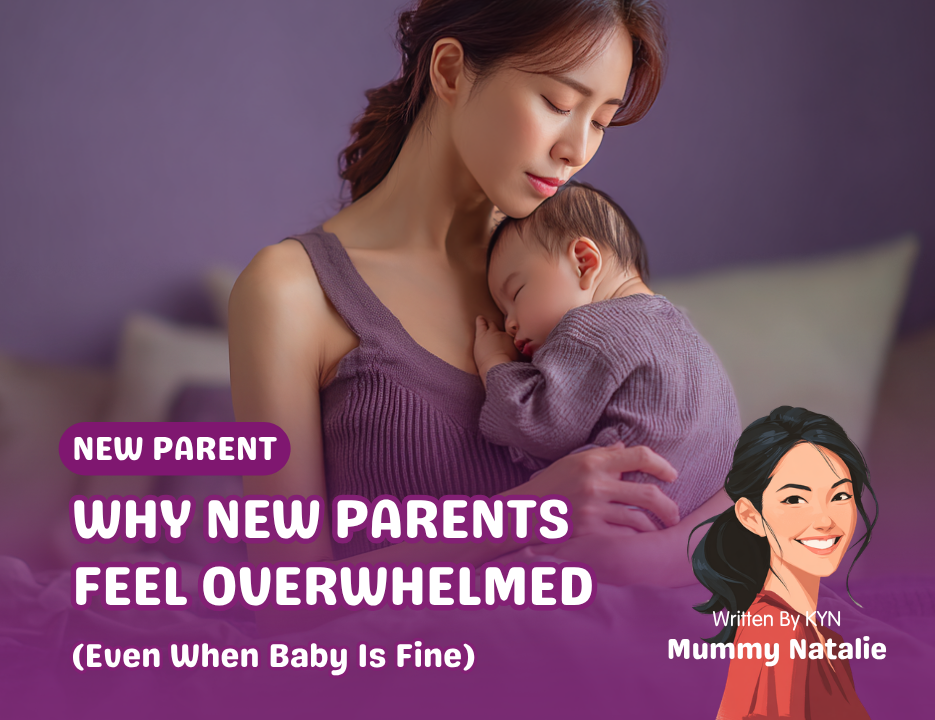
The emotional load of early parenthood is heavier than most couples expect and research shows it’s not just “baby blues”.
When first-time parents bring their baby home, there is often an expectation that joy should naturally take centre stage.
The baby is healthy. Feeding is going well. Family members are checking in. On paper, everything appears to be fine.
And yet, many new parents find themselves feeling anxious, mentally exhausted, and emotionally stretched.
This disconnect between what is happening externally and how parents feel internally is more common than many realise.
In fact, local and international research suggests that the early postpartum period can be one of the most psychologically demanding transitions in adult life.
The hidden emotional labour of new parenthood
A Singapore-based qualitative study on first-time mothers found that anxiety, labile emotions and stress over infant care were among the most prominent themes reported within the first two weeks after hospital discharge.
This means that even when a baby is medically well, parents are often navigating an entirely new mental landscape.
Questions come rapidly and relentlessly:
- Is baby drinking enough?
- Why is the crying different today?
- Should we wake the baby?
- Is this normal?
These decisions are constant, and unlike many other life stages, there are rarely immediate clear answers.
According to researchers from the National University of Singapore, the transition into parenthood is closely linked with heightened stress, emotional vulnerability and the need for structured support systems for both parents and infants.
As one mother shared in a first-time parent forum:
“My world was upside down.”
That single sentence captures what many parents feel but struggle to articulate.
Why the overwhelm happens even when baby is healthy
The pressure does not always come from a crisis.
More often, it builds through the accumulation of multiple small demands.
1. Sleep deprivation changes everything
Research consistently identifies sleep disruption as one of the most significant contributors to parental stress.
A study cited by Mount Alvernia Hospital, with expert input from specialists at KK Women’s and Children’s Hospital, notes that sleep deprivation after childbirth can impair concentration, patience and emotional regulation.
Sleep loss affects more than energy levels.
It can intensify anxiety, lower frustration tolerance and make ordinary decisions feel overwhelming.
For many couples, this becomes most acute around the first three months.
2. Information overload creates decision fatigue
Today’s parents are surrounded by advice.
Doctors provide one framework.
Parents and in-laws may offer traditional guidance.
Social media presents endless routines, hacks and opinions.
Instead of reassurance, this abundance of information can produce paralysis.
A commentary in The Guardian noted that what new mothers often need most is reassurance rather than unsolicited advice.
This is especially relevant in Singapore, where new parents often feel pressure to “get it right” from the start.
3. The identity shift is profound
Experts increasingly use the term matrescence to describe the psychological and emotional transition into motherhood.
Much like adolescence, it is a developmental phase involving identity shifts, emotional volatility and a redefinition of self.
This explains why many mothers say they love their baby deeply while also grieving the loss of their previous freedom and routine.
These feelings are not contradictory.
They are part of the adjustment.
Fathers, too, are affected.
A recent report by Channel NewsAsia highlighted that many fathers in Singapore feel “sidelined” after the baby arrives, with unmet emotional needs and shifting relationship dynamics.
When does overwhelm become something more?
Some level of anxiety in the early days is considered normal.
In fact, clinicians note that mild hypervigilance can be an adaptive response that helps parents attune to their baby’s needs.
However, persistent symptoms such as:
- inability to sleep even when baby sleeps
- racing thoughts
- panic
- excessive guilt
- feelings of hopelessness
may point to postpartum anxiety or depression.
This is not uncommon.
The postpartum period is recognised as a vulnerable mental health window.
The truth many parents need to hear
Feeling overwhelmed does not mean something is wrong with your baby.
And it does not mean you are failing.
Often, it means you are experiencing the very real psychological, physical and emotional demands of becoming a parent.
The early weeks are not simply about caring for a newborn.
They are also about adjusting to a completely new identity, relationship dynamic and way of living.
That adjustment deserves just as much care.
Final word
For expecting couples and first-time parents, perhaps the most important thing to know is this:
A healthy baby does not automatically mean a calm mind.
The emotional transition into parenthood is real, research-backed, and deeply human.
And it is okay to ask for support.
Hello! I am Mummy Natalie

I am one of the editors of KidYouNot Parenting Blog! coffee is my life saviour as a mum of two. My parenting philosophy? Hugs, love, and lots of patience (because honestly, some days need all three). I enjoy sneaking in kopi breaks, spontaneous family makan sessions, and turning everyday chaos into fun memories.
Join KidYouNot SG Parenting Community
Sign up to become a member and gain access to exclusive parenting tips, special deals, and early updates on new products and events.
Follow us on Instagram and Telegram to connect with other parents, share your journey, and enjoy fun, supportive content every day!